




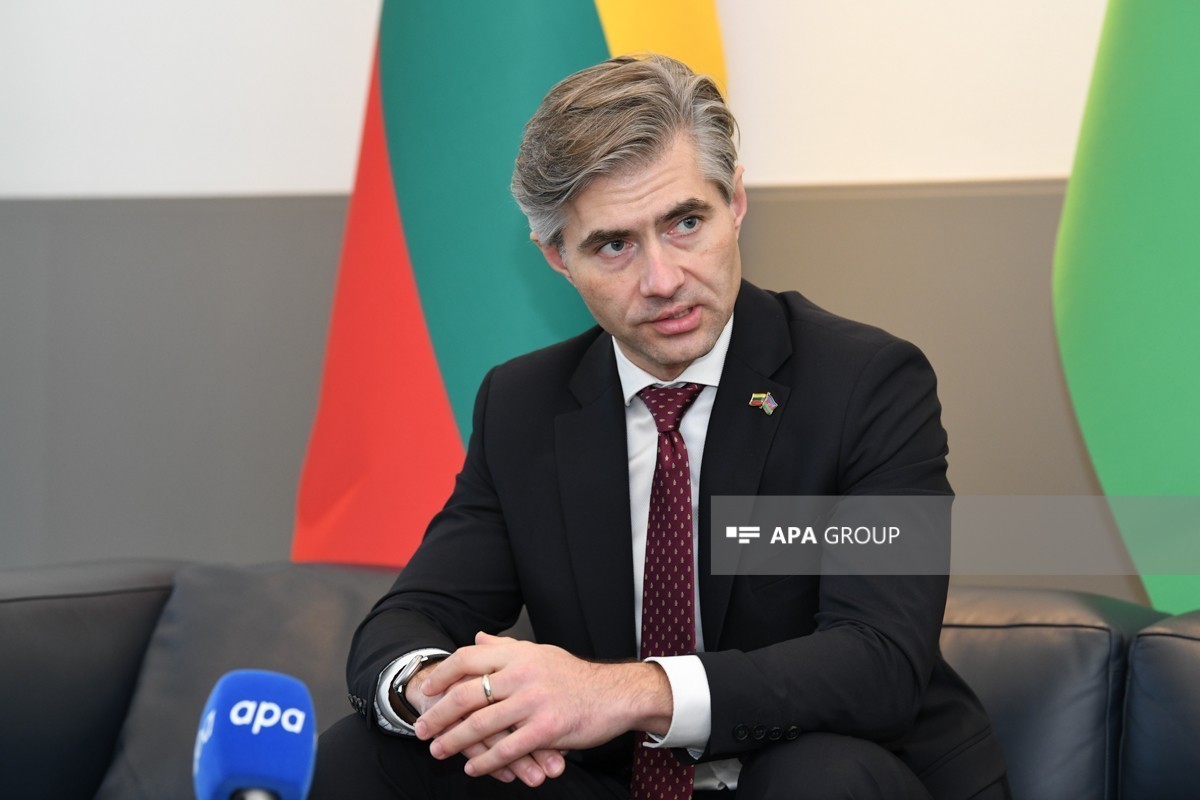

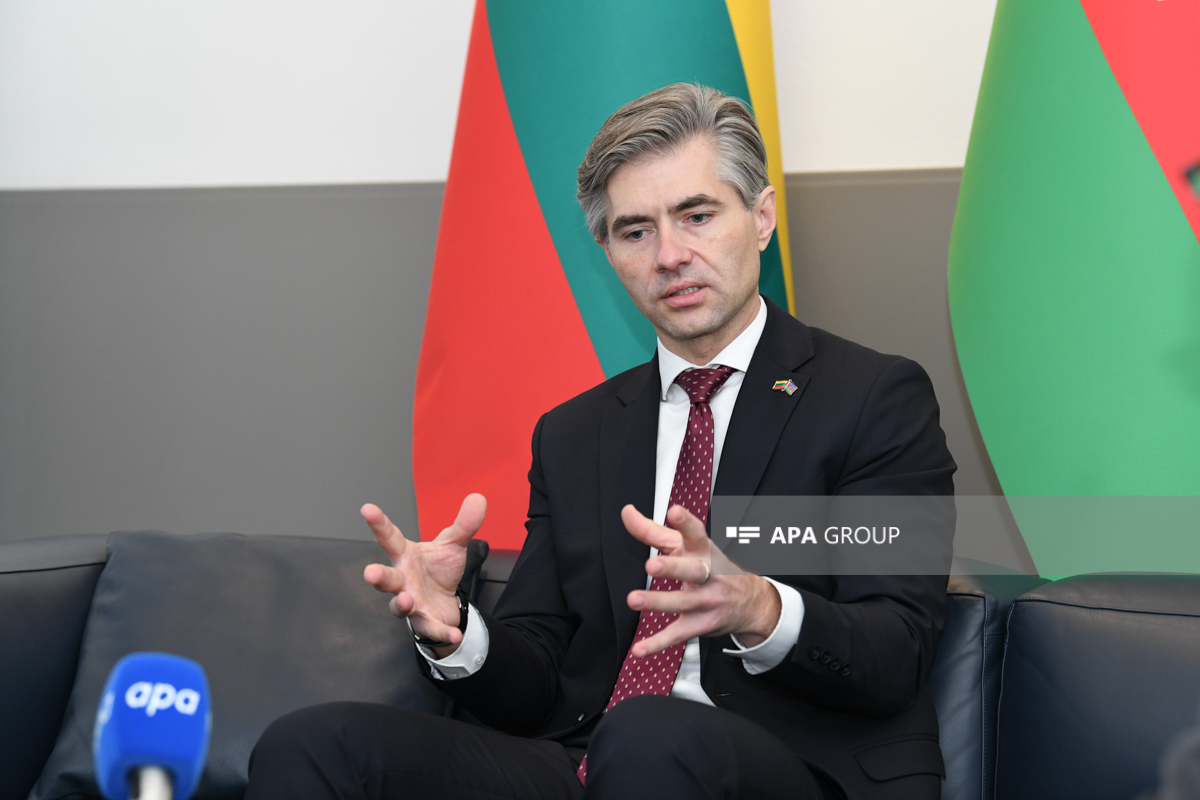
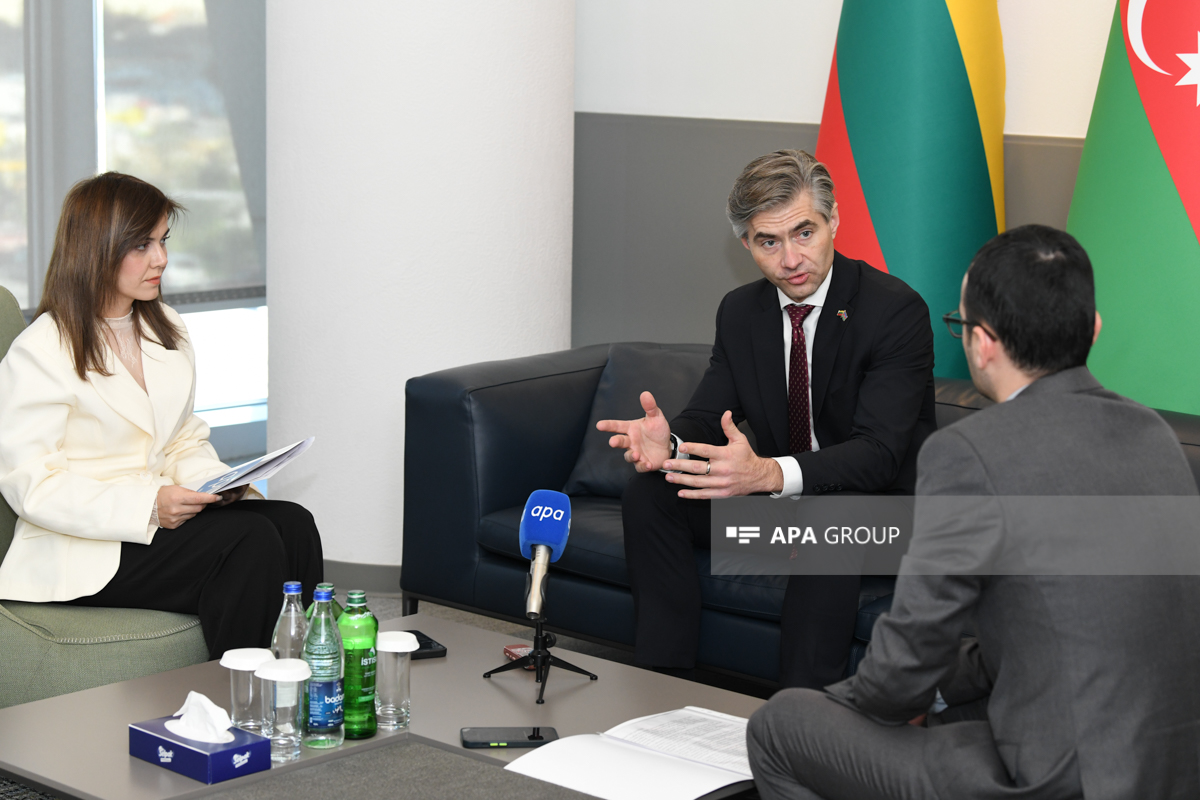
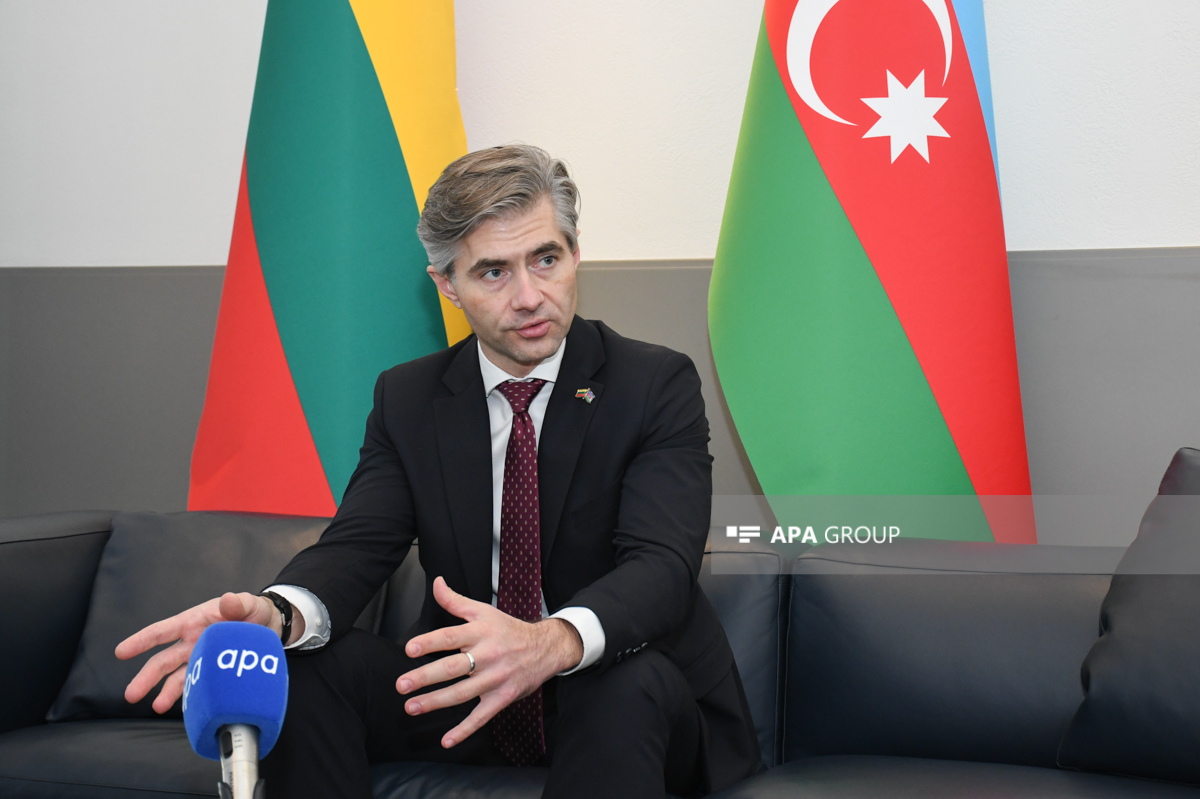
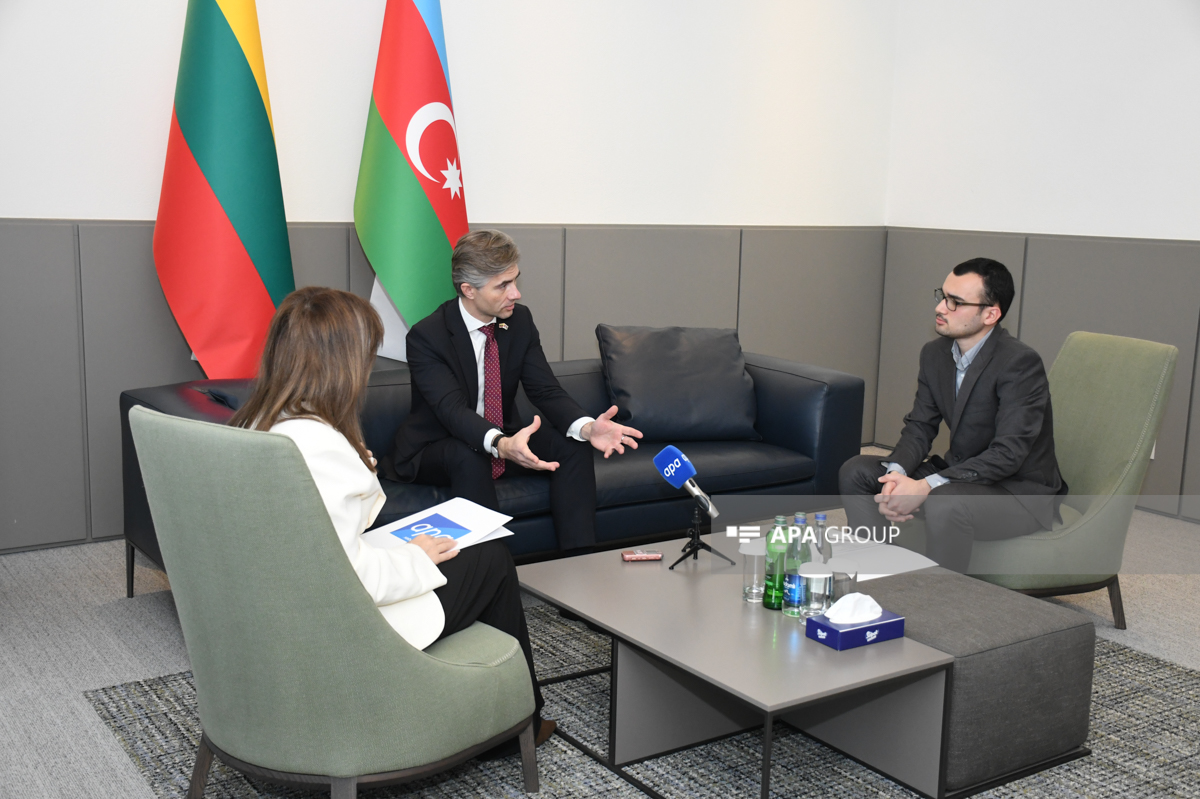
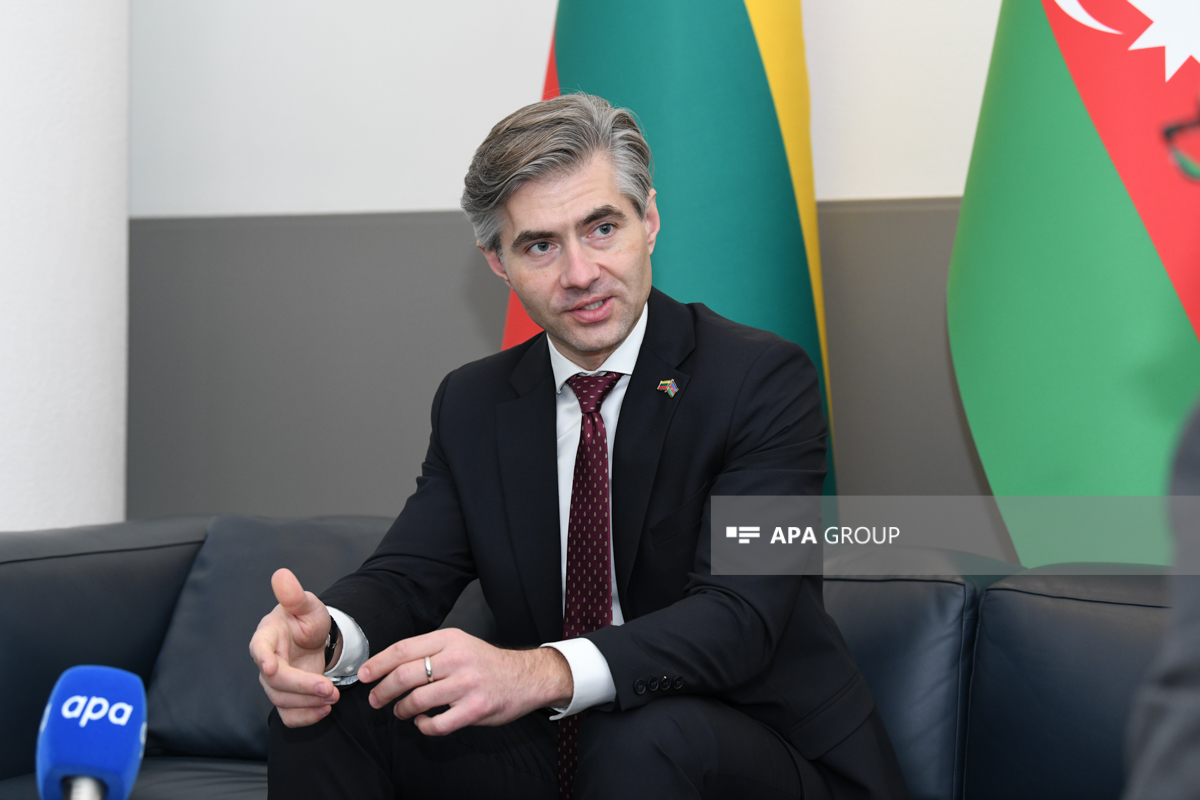
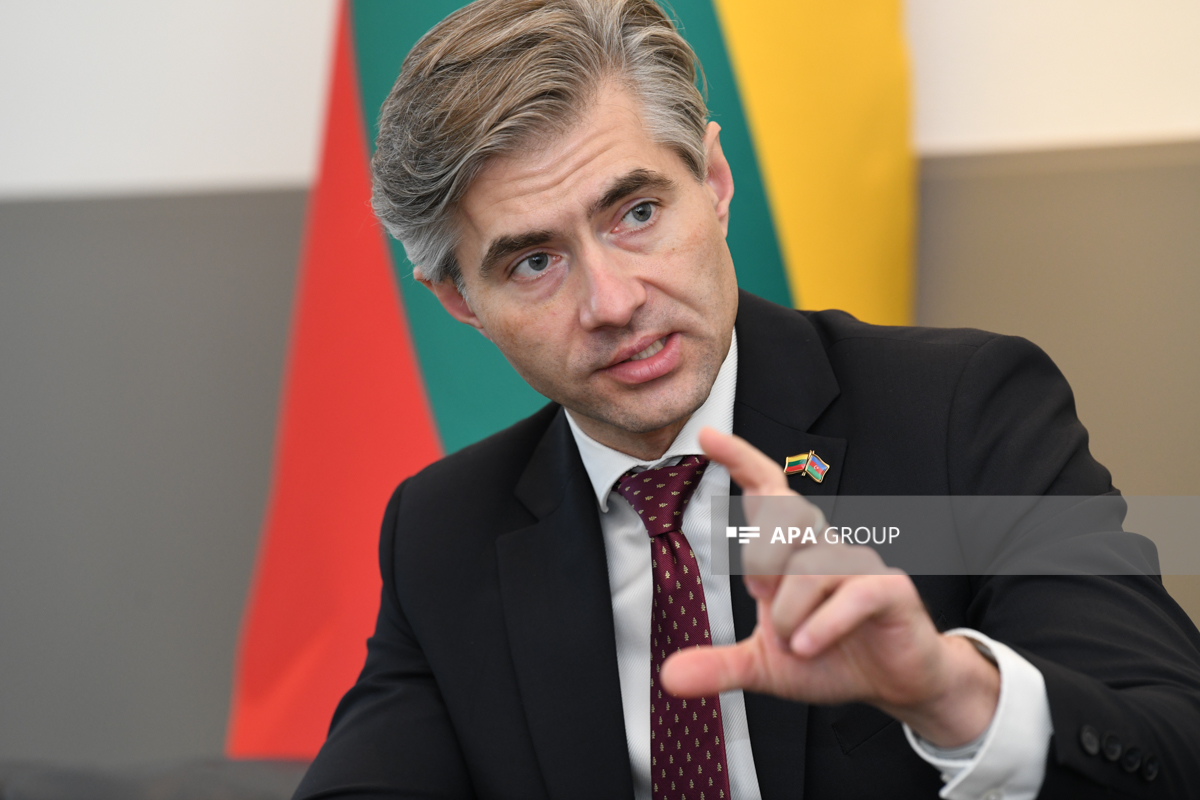
APA conducted an exclusive interview with Lithuanian Foreign Minister Kęstutis Budrys, who is on a visit to Azerbaijan.
I really enjoyed the Sabah–Barcelona match
- Mr. Minister, first of all, thank you very much for taking the time for this interview. My first question will be about the Sabah–Barcelona match. During a joint briefing with your Azerbaijani counterpart Jeyhun Bayramov, you said you would support Sabah, and you watched the match at the stadium. What are your impressions of the match?
- To be honest, I do not consider myself a great football expert who can go into the details of the match and analyze it. But I know who is a great expert in this field. That is Valdas Dambrauskas, the head coach of Sabah. This morning, I had the opportunity to meet him and present him with the Ministry of Foreign Affairs' Diplomacy Star award for his outstanding work in sports diplomacy and his contributions to strengthening ties between Lithuania and Azerbaijan.
As for the match, I can say that I really enjoyed the atmosphere at the stadium and the tremendous support that tens of thousands of people showed for Sabah. It was an incredible experience. It was a wonderful match. After all, you are facing a team like Barcelona. Nevertheless, you manage to achieve your own success. I think it was a very good result.
I was also surprised by the representatives of the Lithuanian community who had gathered in one of the stadium's sections. After the match, I went over to meet them. They were supporting both Sabah and, of course, the wonderful head coach and his entire team.
Yes, I will definitely continue following this club's Cinderella-like story. It is truly a great achievement.
It is also in the European Union's interest to develop closer ties with Azerbaijan
- Yesterday, we witnessed an important milestone in Lithuania-Azerbaijan bilateral relations, as the two countries signed a Joint Declaration on Strategic Partnership. When can we expect to see the results of the implementation of this document?
- The figures will show whether we are making progress in this direction. Of course, it is not just about making statements and announcing slogans. The main goal is to further expand ties between our peoples.
This means more Lithuanians coming to Azerbaijan to discover your beautiful country. At the same time, it means more Azerbaijanis visiting Lithuania, more students coming from Azerbaijan to Lithuania, and the creation of new business opportunities.
We discussed with Azerbaijan's Minister of Economy and business representatives how we could take advantage of these opportunities. We are talking about realizing opportunities that exist at both the political and strategic levels.
It is also in the European Union's interest to develop closer ties with Azerbaijan. The results will be reflected in the figures.
Last year, trade turnover between our countries amounted to 100 million euros. Of this, 40 million euros accounted for goods and approximately 60 million euros for services. We want to increase these figures.
We intend to expand our cooperation in energy, renewable energy, agriculture, tourism, technology, and all other areas that require development.
Lithuania does not offer everything at once. We genuinely offer to share our experience in the areas where we are strongest, while also taking advantage of Azerbaijan's best opportunities.
Azerbaijan is not only a country rich in natural resources with great potential for processing them, but it also has extensive opportunities in other sectors.
Therefore, cooperation in industry and agriculture is of great importance to us.
We must now move to the concrete implementation stage. I think the intensity of our political relations will also be reflected in this transition to a new level.
The leaders of our countries, our presidents, enjoy friendly relations and meet frequently. I also meet your Foreign Minister Jeyhun Bayramov very often. We will make the most of every meeting. I am confident that we will achieve the goals we have set.
In approximately six months, in early 2027, Lithuania will assume the presidency of the Council of the European Union. Of course, during that period, we will pay special attention to developing cooperation between the European Union and Azerbaijan.
One of our goals is to elevate this cooperation to the level of a Strategic Partnership Agreement.
We want to invest in new energy interconnections with Azerbaijan, as well as the development of transport and communication links
- Mr. Minister, you mentioned that Lithuania will contribute to deepening Azerbaijan-EU cooperation. We would like to know how Lithuania will contribute to the negotiation process on a new Partnership Agreement between the European Union and Azerbaijan. In what form will Lithuania participate in this process?
- We will participate directly in this process. As one of the 27 member states of the European Union, and also as a country that will chair certain working groups in which member states decide whether or not to move forward in this direction, we will contribute to the process.
We have all the arguments necessary to justify the importance of introducing a visa-free regime with Azerbaijan. Our goal is to ensure that mutual visits can take place without obstacles.
At the same time, we have sufficient grounds to determine our priorities within the partnership.
As I mentioned, we want to elevate our partnership relations to a higher level and include priority areas in the relevant document.
This will allow us to make more efficient and effective use of the European Union's financial instruments, including the Global Gateway program. This program envisages investment opportunities worth hundreds of billions of euros over the next seven years.
We want to invest in new energy interconnections with Azerbaijan, as well as the development of transport and communication links.
The new transport routes you are building, not only railways and roads but also digital connections, are key areas for the future.
We will use these opportunities to facilitate and expand our trade.
What is happening between the European Union and Azerbaijan cannot be described by any word other than "strategic."
When we say strategic, we mean issues of extremely great importance. We need this, and we see significant added value here.
We must take advantage of this opportunity and not miss this favorable moment.
Especially now, when Azerbaijan is acting as one of the main supporters of ensuring stability and peace in the region and demonstrating its resilience.
This is precisely the most appropriate time.
We will also have an important say in deciding with whom we want to travel freely and develop relations
- You mentioned that Lithuania will chair the Council of the European Union next year. Do you think this six-month period will be sufficient for negotiations on visa liberalization between Azerbaijan and the European Union? As a rule, negotiations on visa liberalization take longer. Do you think we can achieve significant progress in this direction during these six months?
- In many processes, a good start is half the battle. Therefore, first of all, we must start the process. That is our main objective.
Of course, the European Union is an organization consisting of 27 countries, and we must discuss all issues and reach a common agreement.
Many of our decisions are adopted unanimously. Therefore, it is necessary to secure the support of all member states.
The main responsibility of the country holding the presidency is to act as an honest broker and organize the decision-making process.
We have an expression: for this, you need a good pen, a good telephone, and a good microphone.
In other words, you need to call someone to find a solution and compromise, put the agreement reached in writing with a pen, and announce it through a microphone.
That is precisely what our job involves.
Of course, one of the advantages of this position is the ability to influence the agenda and determine which issues we will discuss and in which directions we will work.
Speaking from the perspective of the Council of the European Union, where all member states are represented, I can say that we will also have an important say in deciding with whom we want to travel freely and develop relations.
It will also be our responsibility to promote this direction.
To accelerate the process, we will, of course, try to resolve certain legal and political issues and simplify procedures as much as possible.
I am confident that this is in the interests of all parties.
No one can forget Azerbaijan's significant contribution to NATO-led international operations
- Mr. Minister, Azerbaijan is also a reliable partner for NATO. As one of the most important countries on NATO's eastern flank, how does Lithuania plan to contribute to strengthening military-technical ties between Azerbaijan and NATO?
- We already cooperate very well. I can mention the participation of our military personnel in exercises, as well as our joint activities at various events.
No one can forget Azerbaijan's significant contribution to NATO-led international operations.
During those operations, you demonstrated how close a partner you are to the Alliance.
In addition, I believe that your daily efforts to adapt to NATO standards and bridge existing gaps in interoperability are truly of great importance.
Having a strong partnership between NATO and Azerbaijan is in our interests.
We wanted this partnership to be shaped according to real needs. The experience of recent years has shown that such a partnership is necessary for both sides.
One of the main areas we should focus on in the coming period is strengthening resilience in general.
This includes increasing the resilience of our Armed Forces and ensuring that they receive the best possible support, equipment, and services.
This is one of the main directions of our security cooperation.
At the same time, there are other areas of cooperation.
In general, during our meetings, learning about and listening to your experiences of how various actors from both the north and the south are trying to influence you through hybrid activities is an important learning opportunity for Lithuania and our region as a whole.
I think this experience is very useful in teaching us how to become stronger.
We disconnected from the Russian and Belarusian energy systems and joined the continental European energy system
- A few months ago, Lithuania's former Prime Minister Inga Ruginienė visited Azerbaijan. She said that we should expand our cooperation in the energy sector beyond traditional areas. I mean expanding cooperation in green energy and renewable energy in addition to the oil and gas sector. We would like to know about Lithuania's experience in green energy. Is Lithuania ready to share its experience in this field with Azerbaijan?
- Of course, I completely agree with this idea.
This is the next stage in the development of the energy sector, and the future of energy lies precisely in this direction.
Energy demand will increase significantly around the world. This is clear in terms of demand for both electricity and fuel.
Of course, first of all, we must complete the initial stage. This stage involves expanding energy supplies from Azerbaijan.
Azerbaijan currently proudly ranks fourth among the countries supplying natural gas to the European Union.
The next stage will undoubtedly be renewable and green energy.
Lithuania has undergone a remarkable transformation from a country that generated the vast majority of its electricity at nuclear power plants to a renewable energy system based on solar, wind, and hydropower.
Renewable energy currently accounts for more than 70 percent of our total electricity generation.
By 2030, we will become an exporter of green energy.
Considering Azerbaijan's plans to become a green energy exporter as well, this is a natural and promising direction for our cooperation.
I am learning about many areas in which we are particularly strong in western Lithuania, as well as specific technological solutions.
For example, technological solutions related to the construction of electricity grids and solar power generation.
One of the few companies producing solar panels on the European continent is also located in Lithuania.
In addition, given the variability of solar and wind power generation, another important issue is how these energy sources can be integrated into the electricity grid.
We have energy storage solutions in this area.
In fact, we have one of Europe's largest battery parks designed to meet the needs of the overall energy system.
At the same time, we have experience in developing interconnections with other energy systems.
As a result of an initiative we recently implemented, which we call the project of the century, we disconnected from the Russian and Belarusian energy systems and joined the continental European energy system.
I think this is a clear example of the great success we have achieved and the experience we can offer to other countries.
If you want to strengthen regional integration and establish reliable energy interconnections, you can benefit from our experience.
We are ready not only to share our experience but also to participate directly in these projects.
Lithuania also plays an important role in ensuring the security of natural gas supplies through our LNG terminal.
Our terminal operates as a regional energy hub.
We are looking for opportunities to expand our network of partners in this area and create new trade opportunities.
Thus, although we are smaller in terms of territory and economy compared to some of our larger neighbors in the European Union, we are quite flexible and strong in certain areas.
In some fields, we are a competitive country with substantial expertise.
Therefore, when discussing specific sectors, projects, and opportunities to share our experience, I can confidently say that we are among the countries with the best expertise in precisely those areas.
The Middle Corridor and other projects are an absolute priority for us
- Despite the very high level of political contacts between our countries, our trade turnover remains relatively low. Does Lithuania plan to invest in Azerbaijani sectors such as logistics and agriculture?
- This was one of the issues I addressed at the business roundtable.
My responsibility is to increase these figures.
As I said, 100 million is not enough. We must expand our trade in both services and goods.
As for goods, we need better transport and logistics connections.
Particularly when it comes to trade and the transportation of agricultural products, we cannot allow them to spend weeks in transit.
We need fast transport connections.
That is why the Middle Corridor and other projects are an absolute priority for us.
This is also an additional reason why we sincerely support transport projects and offer our own solutions.
These projects will expand freight transportation opportunities.
We want cargo to move toward southern Türkiye and then northward.
At the same time, it is important for Europe to establish stronger connections from the Adriatic Sea to the Baltic Sea.
This will facilitate trade.
Some of the potential remains untapped because more connections between companies are needed.
Work is currently underway in precisely this direction.
Companies are meeting with potential partners, and I believe these meetings will create new opportunities.
After that, as they say, the magic begins.
As information about successful results spreads, it attracts others as well.
Thus, success leads to further success.
I hope this positive momentum will continue.
We must also take advantage of this opportunity in energy trade.
It can be compared to football.
When you hear about victories and follow what is happening in the Champions League, it attracts people's attention.
At the same time, it also attracts funding, various resources, and support from others.
We need precisely this kind of effect in business as well.
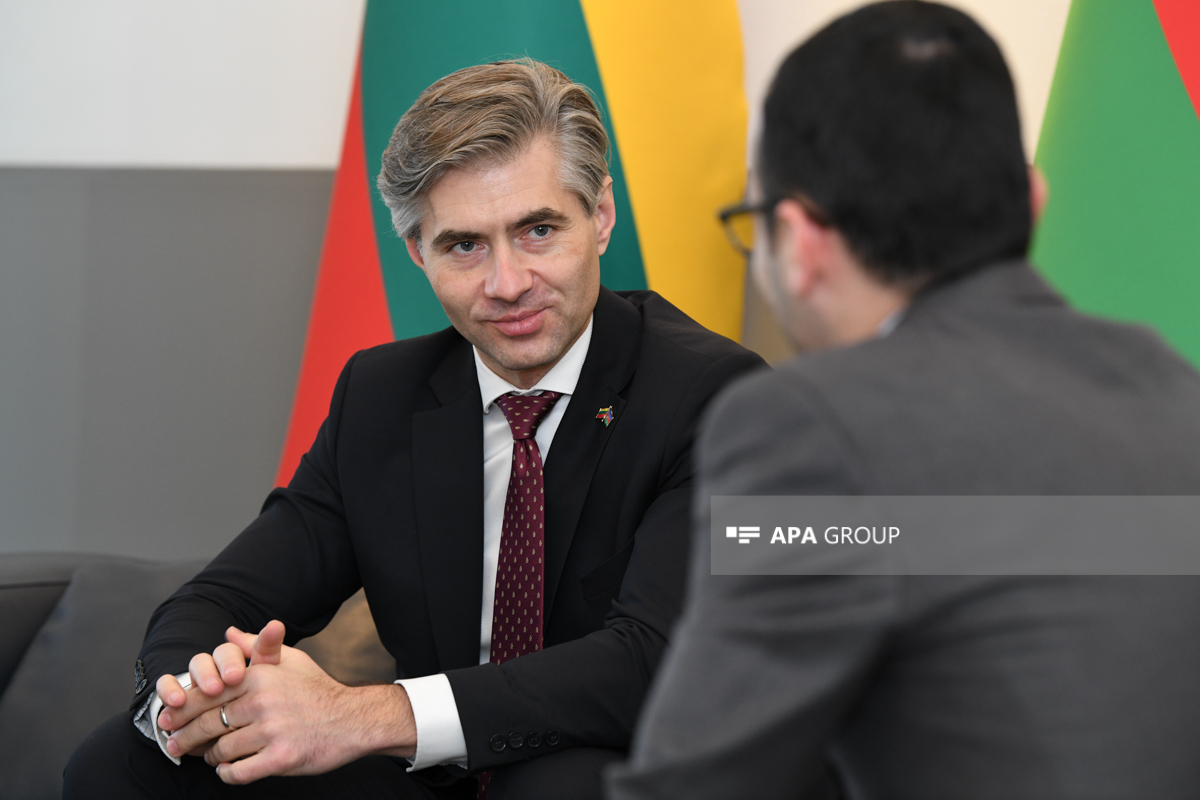
I would be very pleased to visit Karabakh
- Mr. Minister, large-scale restoration and reconstruction work is currently underway in Karabakh and Eastern Zangezur, which have been liberated from Armenian occupation, and Smart City and Smart Village projects are being implemented. Lithuania is one of Europe's leading countries in digital governance, environmentally sustainable urban planning, and engineering solutions. Have you come to Baku with specific proposals for Lithuanian companies to participate in this process? And do you plan to visit Karabakh in the future?
- Yes, of course, I would be very pleased to visit Karabakh.
This is my first visit to Azerbaijan. Naturally, there is a lot for me to discover here.
As for the issues we are proposing, we have not yet discussed the details of urban planning and various technological solutions.
I am confident that we can find partners in these areas.
As for Karabakh, unfortunately, we have had to gain experience in demining in Ukraine, and we have offered to share this experience with Azerbaijan.
Together with Iceland, we call this the Demining Capability Coalition.
We want to expand this experience and apply it in other territories as well.
This is one of the areas in which we can cooperate.
Because, for cities to expand and develop and for business activities to be established, the land must first be cleared of mines and made suitable for use.
This could be precisely where we make our contribution.
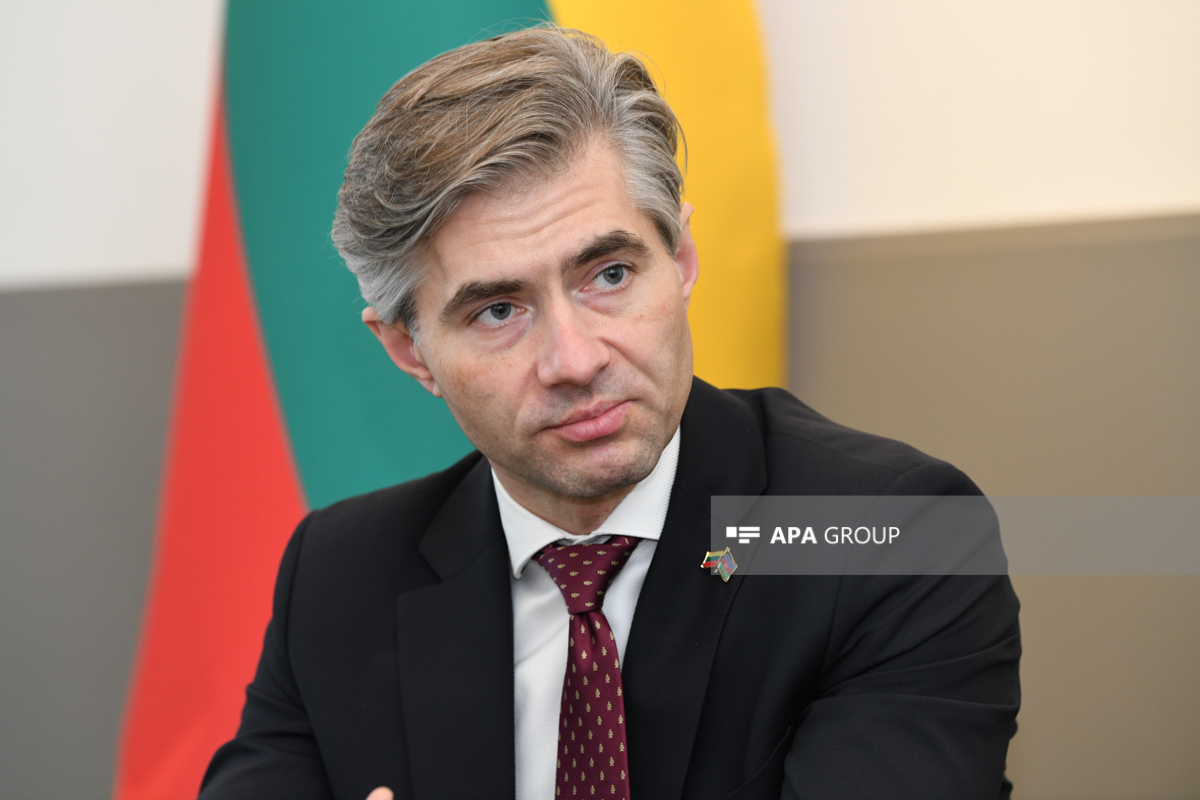
I invited Azerbaijan to the Ukraine Mine Action Conference to be held in Vilnius next year
Lithuania has a Central Project Management Agency operating in the field of demining.
This institution manages and coordinates all our capabilities.
The coalition can also be very useful in this regard.
I know that the European Union also wants to contribute to this process and is allocating financial resources for this purpose.
We will also be part of this process.
In addition, I invited Azerbaijan to the Ukraine Mine Action Conference to be held in Vilnius next year.
This conference will bring together both countries affected by landmine contamination and countries with demining capabilities.
When you need to clear your territory of mines, it is through precisely this kind of cooperation that you gain experience and knowledge.
Next year's meeting in Vilnius will be a great opportunity to share best practices.
It will also be of great importance in developing successful projects that will allow the demining process in Azerbaijan to be carried out more rapidly.
- Mr. Minister, finally, thank you once again for taking the time for this interview.
- I would also like to thank you.
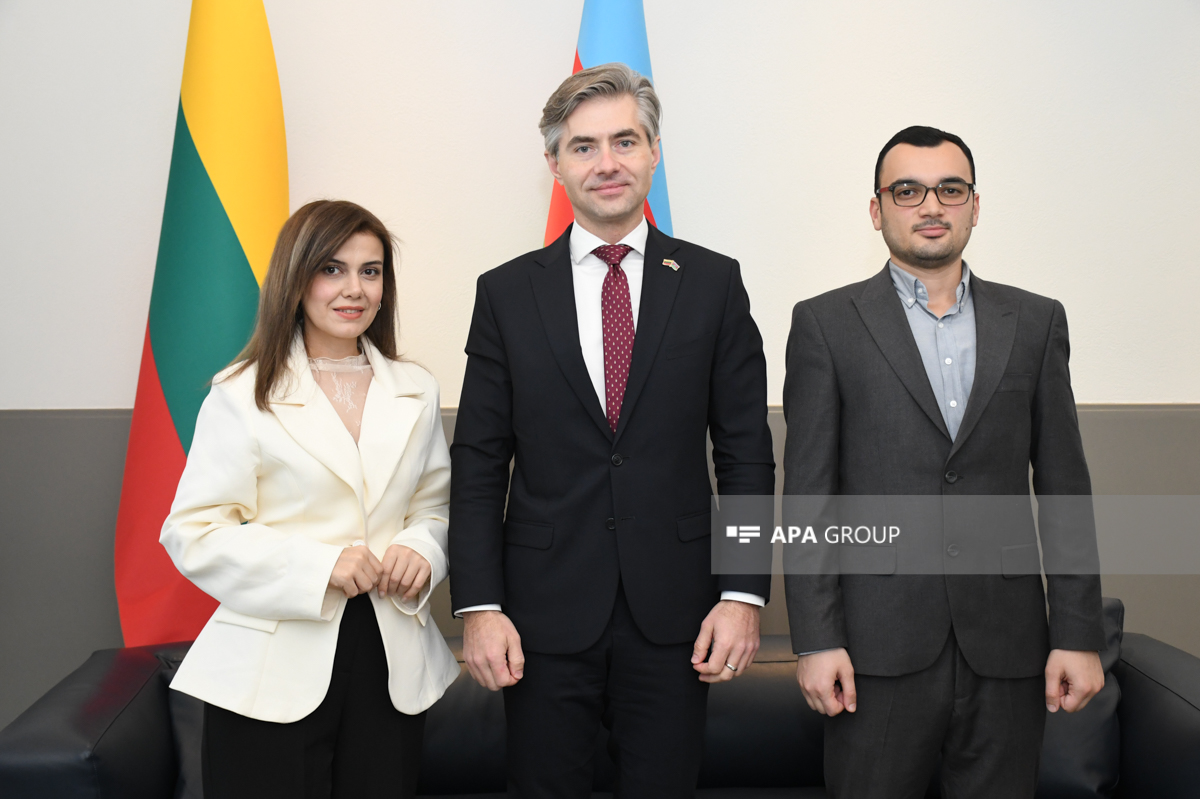
Firuza Vahid
Toghrul Guluzade
Photo – Ilkin Nabiyev © APA GROUP


 Follow us on Telegram
 t.me/apanewsaz
 Follow us on Instagram
 Follow us on TikTok
 Follow us on Facebook
 Follow us on X