

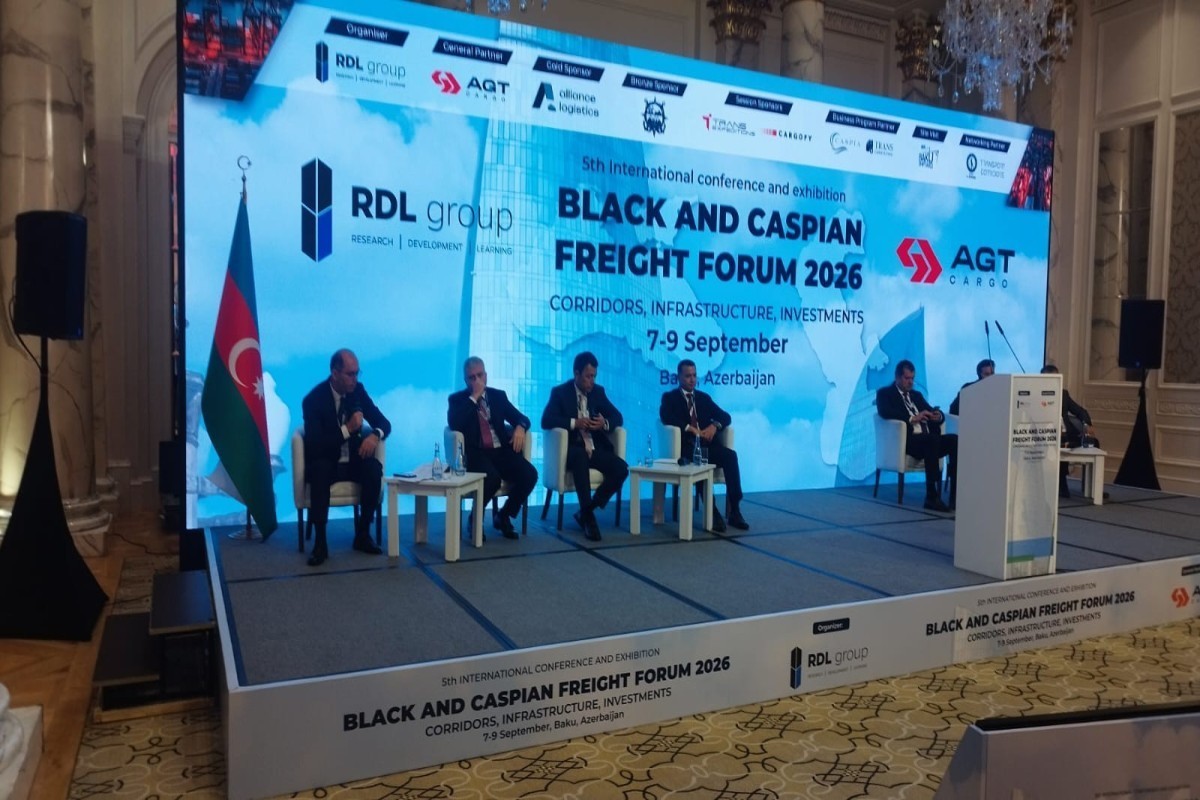


Work is underway to ensure backhaul freight and attract cargo from Europe to the East in order to increase freight volumes along the Middle Corridor, Emil Mammadov, Adviser to the Chairman of Azerbaijan Railways (ADY), said during the Black Sea and Caspian Freight Forum 2026, APA-Economics reports.
According to him, ensuring backhaul freight is of great importance for the long-term and systematic development of the Middle Corridor.
“The corridor cannot develop chaotically or in a fragmented manner on its own. We are working to ensure that the development of the corridor takes place systematically. For this, backhaul freight is necessary,” Emil Mammadov said.
He noted that ensuring backhaul freight will make it possible to increase freight volumes along the Middle Corridor and optimise transportation costs: “We will have the opportunity to return at least a certain number of containers to their countries of origin.”
According to the ADY official, in recent years, the main focus has been on attracting China-origin cargo and export cargo from Central Asian countries to the Middle Corridor.
“If we are talking about cargo that can be containerised, we mainly mean China-origin cargo. We have worked on attracting this cargo to the Middle Corridor,” he added.
Emil Mammadov said that, in parallel, large-scale infrastructure projects have been implemented along the corridor, including in Kazakhstan, Azerbaijan and Georgia.
According to him, one of the main areas of focus at present is also attracting Azerbaijan’s export cargo that can be containerised. Discussions are being held with several major operators for this purpose.
“Numerous representatives of the logistics industry are also working on various options regarding how we can use the containers at our disposal and what solutions can be applied to ensure the export of Azerbaijani products,” the Adviser to the ADY Chairman emphasised.
He also noted the importance of promoting the Middle Corridor more actively in the European market.
“Today, we have begun active cooperation with our partners in Europe to establish systematic work and ensure the attraction of a cargo base from West to East to the Middle Corridor,” Emil Mammadov said.
According to him, cooperation with local partners is particularly important in promoting the Middle Corridor in Europe:
“On the European continent, concepts put forward by European partners can create greater confidence and predictability.”
Emil Mammadov noted that cargo that could be transported from Europe to the East via the Middle Corridor may include automotive industry products, spare parts and other finished products.
“At present, it is difficult to predict the entire list of products in advance. This is because everything will depend on what opportunities the corridor can offer to shippers,” he said.
The ADY official emphasised that meeting requirements related to transit time and service levels is among the key issues for increasing freight flows from Europe to the East.
“We must meet certain service requirements so that the shipper feels comfortable using the corridor and can bring to the corridor types of cargo that are sensitive not only to transportation costs but also to transit time,” Emil Mammadov said.
He added that the results of the work being carried out in this direction are expected to become clearer from 2027, with the volume of cargo transported from West to East expected to increase systematically.


 Follow us on Telegram
 t.me/apanewsaz
 Follow us on Instagram
 Follow us on TikTok
 Follow us on Facebook
 Follow us on X