





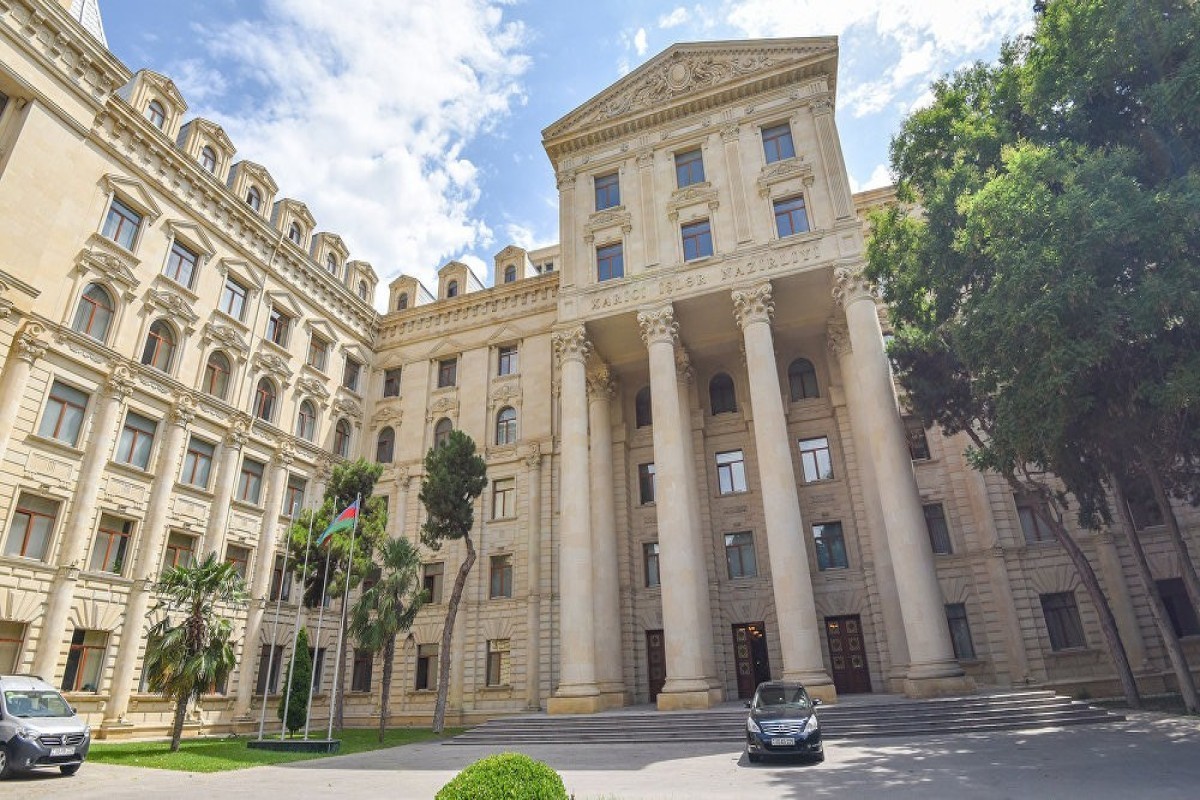


"The recent claims made by Nicolas Forissier, France's Minister Delegate for Foreign Trade and Economic Attractiveness under the Ministry for Europe and Foreign Affairs, regarding the Azerbaijan-Armenia normalization process are completely unacceptable. France's continued reliance on a selective approach, one-sided assessments, and politically motivated narratives does not contribute to advancing the peace agenda in the region," Azerbaijani Foreign Ministry spokesperson Aykhan Hajizada said in his comments on the matter, APA reports.
According to the statement, the anti-terror measures carried out by Azerbaijan in September 2023 were aimed at ending the illegal military presence and activities of the Armenian armed forces and their affiliated structures in the sovereign territories of the Republic of Azerbaijan, restoring the country's constitutional order, and ensuring its sovereignty and territorial integrity. These measures were carried out in accordance with international law, including the relevant provisions of the UN Charter.
Attempts to portray these measures as violations of international law, while disregarding the decades-long occupation, ethnic cleansing, and systematic violations of the rights of hundreds of thousands of Azerbaijanis, are unacceptable.
The Foreign Ministry spokesperson's comments read:
"Regarding humanitarian issues, Azerbaijan rejects attempts to portray individuals who have been prosecuted or convicted in the country as 'arbitrarily detained' persons. Those held accountable include individuals accused and convicted of serious crimes, including war crimes, crimes against humanity, and terrorism. Their cases have been examined in accordance with Azerbaijan's national legislation and relevant international obligations. Attempts by foreign parties to demand the release of individuals convicted of serious war crimes are inconsistent with the principle of the rule of law.
Azerbaijan categorically rejects allegations concerning the destruction or deliberate alteration of cultural and religious heritage. The protection and restoration of cultural heritage monuments in the liberated territories remain among our country's consistent priorities. At the same time, it is important not to overlook the widespread destruction and appropriation of the cultural and religious heritage of the Azerbaijani people, including mosques, cemeteries, and other historical monuments, during Armenia's decades-long occupation.
We recall the importance of giving equal attention to the rights of hundreds of thousands of Azerbaijanis forcibly expelled from their homes in Armenia and Azerbaijan's formerly occupied territories, including their right to return safely and with dignity. A selective approach to humanitarian issues undermines the credibility of appeals concerning international law and human rights.
It is also noteworthy that the French Government assumes the position of passing judgment on the internal affairs of other states instead of addressing serious concerns regarding its own human rights and governance situation. The excessive use of force by French law enforcement agencies against protesters, including minors, has repeatedly raised serious concerns. Reports of serious injuries during student protests in France, as well as the launch of numerous investigations into unlawful actions by police officers, further heighten these concerns.
Furthermore, ongoing judicial proceedings and corruption investigations involving French political figures, including members of parliament, raise legitimate questions about transparency, public accountability, and the integrity of state institutions. Rather than engaging in selective criticism and politically motivated assessments of other countries, France should first focus on addressing these problems within its own borders."
In conclusion, Aykhan Hajizada called on the French Government to abandon its biased approach and refrain from interfering in Azerbaijan's internal affairs.


 Follow us on Telegram
 t.me/apanewsaz
 Follow us on Instagram
 Follow us on TikTok
 Follow us on Facebook
 Follow us on X