






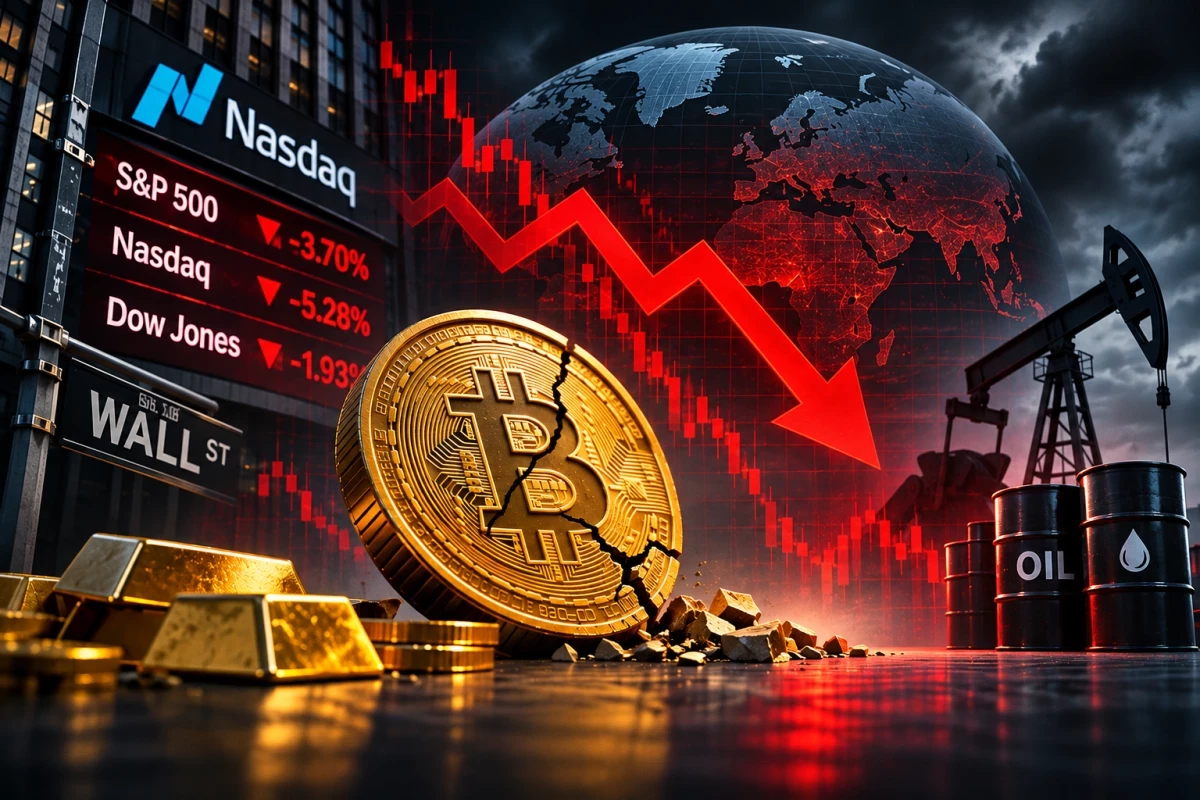


Global financial markets are experiencing one of the most significant waves of selling in recent times. Sharp declines in US stock indices, falling share prices of technology companies, Bitcoin's drop to its lowest level since September 2024, and fluctuations in the gold market indicate a shift in investors' attitudes toward risk.
The main issue is not merely the decline in stock and cryptocurrency prices. The more important question is: Why is selling intensifying simultaneously across different financial markets, and what does this process mean for the global economy?
An analysis of the current situation shows that it would be incorrect to attribute the wave of selling to a single event. US monetary policy, the profitability of investments in the artificial intelligence sector, borrowing costs, investors' liquidity needs, and geopolitical risks are all interconnected factors influencing the situation.
How the crisis began: The AI boom, expensive credit, and changing investor expectations
The roots of the current sell-off in global financial markets date back to mid-2026. During that period, investors began to assess more seriously the actual profitability of large investments in the artificial intelligence sector.
In recent years, growing interest in artificial intelligence technologies has significantly contributed to increases in the market valuations of Nvidia, Microsoft, Alphabet, and other technology companies. Expectations of substantial investments in the construction of data centers, the purchase of high-performance chips, and the expansion of computing infrastructure supported this growth.
However, over time, the market's main question changed: How long will it take for the substantial funds invested in artificial intelligence to generate profits, and how large will those profits be?
These concerns initially became apparent in the shares of individual technology companies but subsequently spread to the broader market.
From August to November: Timeline of the sell-off
Mid-2026 – Initial concerns
Questions grow about the high market valuations of artificial intelligence companies and the profitability of major infrastructure expenditures. Investors begin to fear that valuations in the technology sector may have risen excessively.
August – Global stocks reach their peak
Global stock markets reach high levels. As a result of the decline in subsequent months, approximately $9 trillion is reportedly wiped off the total market capitalization of global equities between that peak and November 20.
October – Monetary policy pressures intensify
Persistent inflation in the United States and other major economies increases the likelihood that interest rates will remain high or be raised again. The prospect of more expensive borrowing becomes a negative factor, particularly for companies financing large investment programs through debt.
Early November – Political and corporate risks increase
Political uncertainty in the United States, potential restrictions on data center construction, and corporate developments in the technology sector make investors more cautious.
November 16–20 – Selling accelerates sharply
Declines in technology company shares spread to other sectors and countries. Major US stock indices record significant losses, while Bitcoin falls to its lowest level since September 2024.
Thus, it would be incorrect to date the beginning of the current decline solely to November. The roots of the problem emerged in the middle of the year, intensified in October, and developed into a large-scale sell-off in the third week of November.
Why are all markets falling simultaneously?
One of the main reasons is the change in expectations regarding the future direction of the cost of money, namely interest rates.
Persistently high inflation in the United States has increased the likelihood that the Federal Reserve will maintain a restrictive monetary policy.
High interest rates increase borrowing costs for companies. At the same time, they reduce the present value of profits expected to be earned in future years. This effect is particularly pronounced among technology companies whose valuations are high because of their future growth prospects.
Another important factor is the spread of risks associated with the artificial intelligence sector throughout the global financial system. Shares of US technology companies account for a significant portion of investment fund portfolios in various countries.
When the value of these shares falls, the overall performance of the funds deteriorates, potentially forcing investors to sell other assets as well.
As a result, selling is not limited to technology stocks.
Why is Bitcoin falling alongside stock markets?
Despite the view that cryptocurrencies operate independently of the traditional financial system, Bitcoin has increasingly become part of major investment fund portfolios in recent years.
Consequently, when global investors begin reducing their exposure to risk, cryptocurrencies also face selling pressure.
On November 21, Bitcoin's price fell to around $56,000, its lowest level since September 2024. According to CoinMarketCap data, the price has declined by more than 16% over the past week and more than 32% over the past 30 days.
An additional mechanism deepening the decline in the cryptocurrency market is leveraged trading. When investors open large positions using borrowed funds, a decline in prices below a certain threshold triggers the automatic liquidation of those positions.
Thus, an initial price decline generates further selling, which in turn accelerates the fall in prices.
Outflows from cryptocurrency exchange-traded funds (ETFs) also intensify this process.
Why is gold also becoming cheaper?
Under normal circumstances, investors tend to favor gold when uncertainty in stock markets increases. However, gold prices are also declining during the current sell-off.
One possible explanation is investors' growing need for liquidity, meaning readily available cash.
An investor who has suffered substantial losses in the stock market may sell other assets, including gold, to raise funds. In such circumstances, gold's status as a safe-haven asset is not sufficient to protect it completely from short-term selling pressure.
At the same time, a stronger dollar and higher bond yields can also negatively affect gold prices.
This situation highlights an important distinction: Investors shifting from risky assets to safe-haven assets is not the same as investors selling all their assets to accumulate cash. Signs of the latter behavior are also visible in the current market.
Could this be a repeat of the 2008 financial crisis?
Although there are certain similarities between the current situation and the 2008 global financial crisis, it would be incorrect to equate them.
In 2008, the crisis centered on bank balance sheets, mortgage loans, and the solvency of financial institutions.
The current decline, however, is primarily associated with high asset valuations, expectations of restrictive monetary policy, and investors' retreat from risk.
Nevertheless, the risks have not disappeared completely. If the decline in stock markets makes financing more difficult for companies, increases credit risks, and spreads to the real economy, the situation could become more serious.
Therefore, at this stage, it is more reasonable to characterize the current situation as a broad market correction and a tightening of financial conditions rather than a global financial crisis.
Conclusion: Is the world on the brink of a new crisis?
The developments of November 2026 could mark a significant turning point in global financial markets.
Technology companies that have gained value for years on expectations of high profitability are now facing more rigorous valuations. The possibility that interest rates will remain high is changing investors' decisions, while concerns about the artificial intelligence sector are spreading to other markets.
The most striking aspect is that, alongside stocks, cryptocurrencies, gold, and industrial metals have also come under selling pressure. This indicates that investors are not simply shifting from one asset class to another but, in some cases, are reducing their overall exposure to risk.
However, the loss of trillions of dollars in market value across global stock markets does not mean that an equivalent amount of cash has left the economy. Rather, it primarily reflects a decline in the market valuation of assets.
Whether the current wave of selling develops into a global financial crisis will depend on several factors: future inflation trends in the United States, the Federal Reserve's interest rate decisions, the financial results of technology companies, conditions in credit markets, and investors' attitudes toward risk.
If the sell-off remains limited to highly valued assets, the market could stabilize after some time. However, if the decline seriously affects lending, investment, and employment, problems in financial markets could spread to the real economy.
In other words, global financial markets are currently facing not only falling prices but also a reassessment of investment expectations formed in previous years.


 Follow us on Telegram
 t.me/apanewsaz
 Follow us on Instagram
 Follow us on TikTok
 Follow us on Facebook
 Follow us on X