





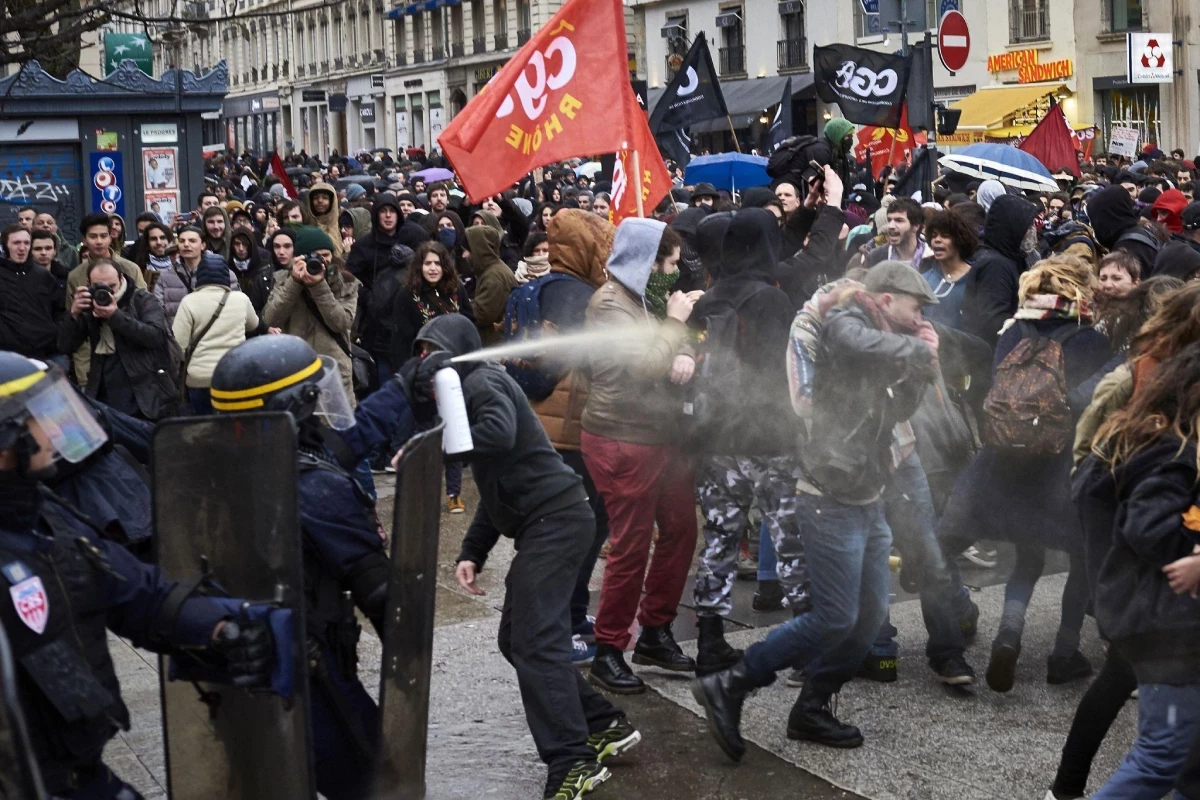


More than 250,000 people have taken to the streets of France this Thursday as part of the general strike driven by the main trade union confederations, a day of protest that, according to the French General Confederation of Labour (CGT), has spread to more than 70 cities across the whole country, Demócrata reports.
The figures, updated around 13:00 hours (local time), correspond to a day of great intensity in which it is expected that up to 700,000 people will take part in the marches. Of that total, between 40,000 and 80,000 will concentrate only in Paris, the capital, a volume slightly higher than that recorded in previous calls for demonstrations. So far, around 250 actions and demonstrations have been organized, according to data released by the CGT. Meanwhile, the Government has assured that it remains “extremely alert,” as emphasized by the spokesperson, Maud Bregeon, who has said that “there is no way, not even remotely, to go back to living through, in any way, what was experienced on 17 October,” a day marked by serious episodes of violence and looting.
The strike also has the support of secondary school and university students, who extend the movement that began in mid-September and which has helped to intensify protests against the high cost of living, the situation of public education, and the difficulties in accessing housing. Other groups have joined these mobilizations, such as the agricultural sector and the so-called “yellow vests.”
On Wednesday night, the Minister of the Interior, Laurent Nuñez, announced that 70,000 police officers and gendarmes would be deployed for today’s day and promised an “extremely firm” response to any possible “disturbance.”
In the same vein, he has insisted on the need to provide a “firm” response to any violent episode and specified in a communiqué that the deployment includes specialized units, as well as the use of drones, helicopters, mounted units, canine units, 26 armored Centaure vehicles of the Gendarmerie, and around a dozen amphibious vehicles. The operation includes 110 mobile units and specific resources to anticipate and stop any possible clashes, looting, or damage against shops, infrastructure and public assets. In addition, the authorities have maintained contacts with trade union organizations and prefects in order to agree on routes that minimize risks.
The authorization of the marches is conditional on the routes avoiding "sensitive areas", including some urban centers where incidents have already been recorded in the past, and on the unions having their own resources to ensure control of the gatherings. At the same time, the Ministry of the Interior has ordered exhaustive checks on roads, railway lines and stations before the start of the demonstrations. The objective, according to the department’s guidelines, is "to ensure the peaceful development of the marches" and to prevent possible violent actions around them.
From early in the morning, the state security forces remain deployed at the key points of the calls to carry out checks, deter incidents and protect the participants in the protests.


 Follow us on Telegram
 t.me/apanewsaz
 Follow us on Instagram
 Follow us on TikTok
 Follow us on Facebook
 Follow us on X