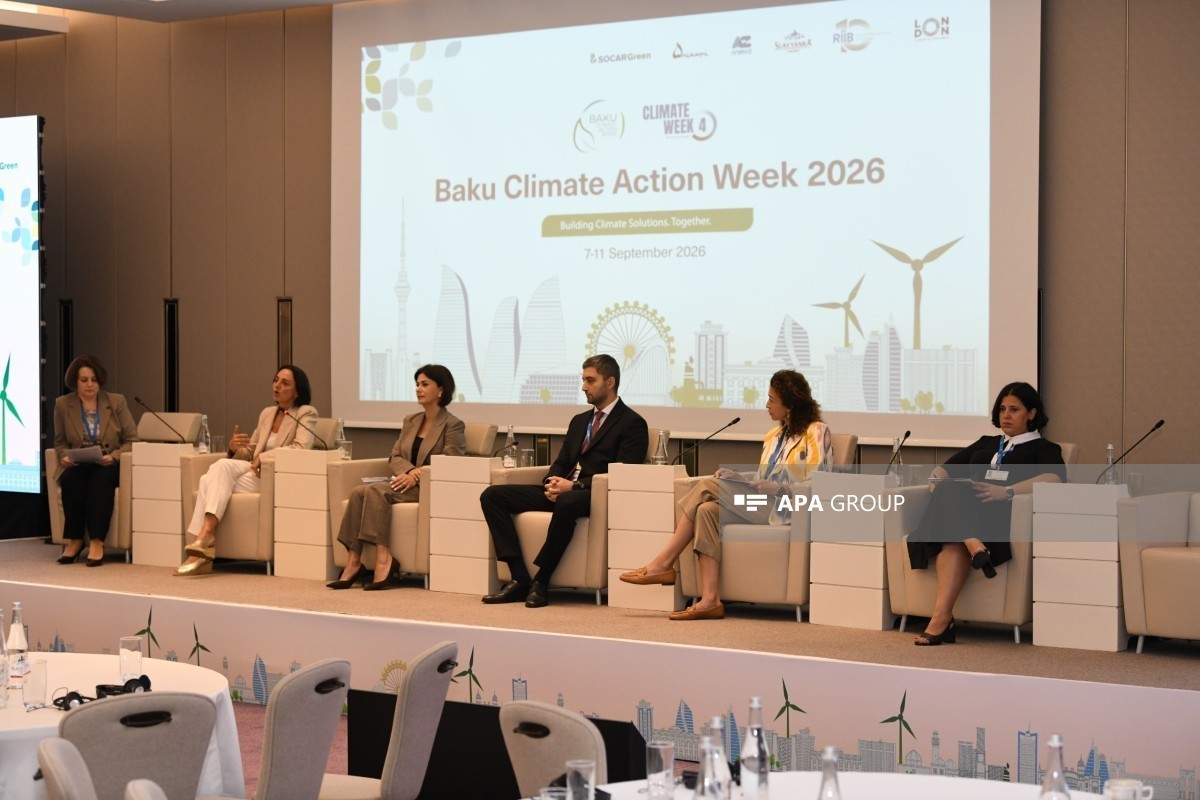


Another panel session has been held as part of the Fourth Climate Week (CW4) conference of the United Nations Framework Convention on Climate Change (UNFCCC), APA reports.
During the session, views were expressed on developing the green energy industry through innovation, digital technologies and regional cooperation.
Petra Schwager, a senior official and climate technology policy expert at the United Nations Industrial Development Organization (UNIDO), said that Azerbaijan should use hydrogen not only for exports but also for industrial development.
According to her, UNIDO launched a programme on clean hydrogen in industry five years ago. One of the main goals of the programme is to encourage countries to consider new opportunities for industrial development through the use of hydrogen, while also promoting the decarbonization of existing industry.
Schwager noted that public policy, financing, certification, innovation, capacity building and sustainability are key factors for the development of the hydrogen sector.
Aysel Yagubova, Executive Director of the ECO Clean Energy Center (CECECO), said that more than 200 projects had been submitted as part of the Clean Energy Hackathon 2026, aimed at developing innovative solutions for clean energy and energy transition in the ECO region.
The submitted projects included proposals for platforms, websites and mobile applications aimed at increasing energy efficiency, using renewable energy sources more efficiently and realizing the region’s renewable energy potential.
Elmir Musayev, CEO of SOCAR Green, said that SOCAR Green is expanding cooperation with international partners in the field of renewable energy.
He noted that SOCAR Green is implementing joint projects with international companies in order to rapidly develop know-how and practical experience in the field of renewable energy in the country.
According to Elmir Musayev, the company’s strategy, along with implementing joint projects with international partners, is to develop the practical experience of local personnel and technical know-how in the field of renewable energy in Azerbaijan.
Nargis Wieck, Executive Director of the German-Azerbaijani Chamber of Commerce (AHK Azerbaijan), said that German companies are interested in participating in Azerbaijan’s energy transition.
She stated that German companies are considering both the export of technology and equipment and investment opportunities in the field of energy transition in Azerbaijan.
It was noted that the challenges ahead could also create new opportunities. In this regard, first of all, there is a need to provide the German business community with more detailed information about the processes taking place in Azerbaijan and the region. Increasing awareness in Germany about connections with the Caspian region and Central Asia was also highlighted as one of the important issues.
It was stated that Germany has decades of experience in the field of energy transition. Awareness-raising, education and the participation of various segments of society play an important role in this process. The importance of this approach in Azerbaijan’s energy transition was also emphasized.
Overall, the speeches focused on renewable energy projects, green hydrogen, attracting foreign investment, strengthening energy infrastructure, cooperation with Germany and other countries, as well as the participation of local companies in this process.


 Follow us on Telegram
 t.me/apanewsaz
 Follow us on Instagram
 Follow us on TikTok
 Follow us on Facebook
 Follow us on X