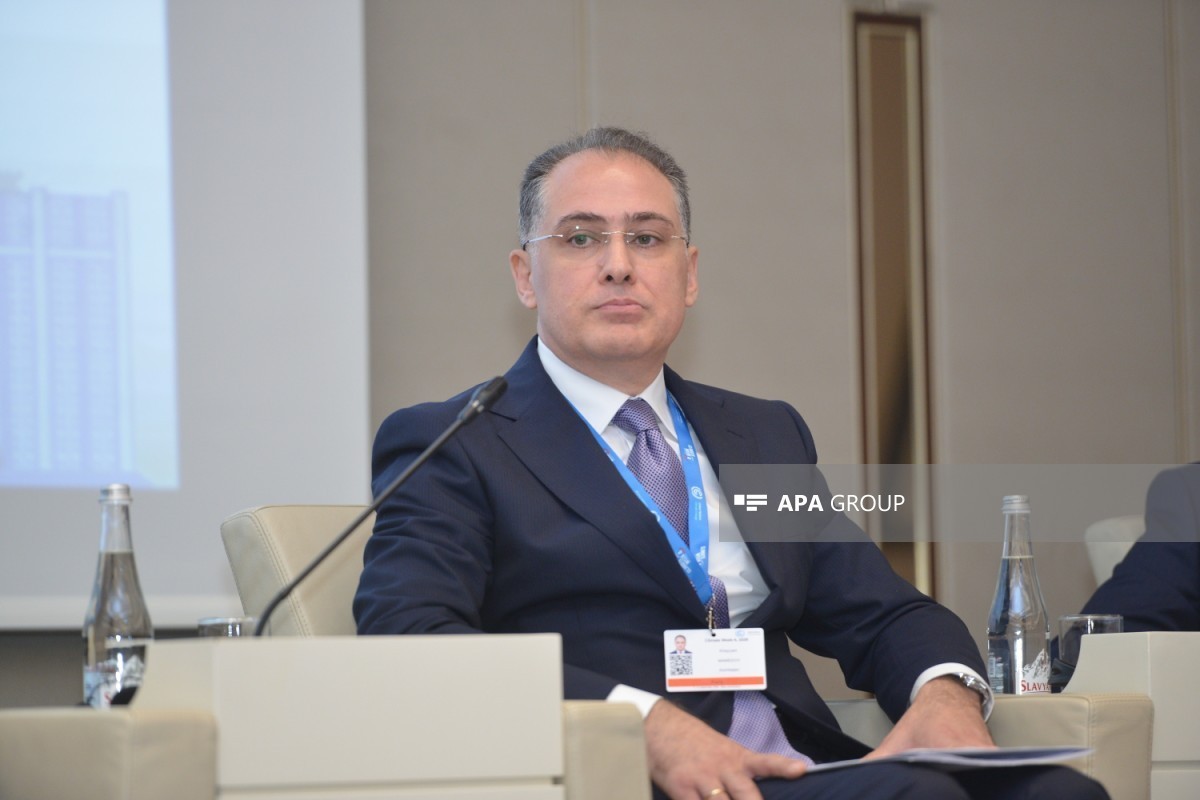


Our country is highly dependent on transboundary rivers, and climate change is creating new challenges not only for our country but for the region as a whole, First Deputy Chairman of the Azerbaijan State Water Resources Agency (ADSEA) Khayyam Mammadov said during a panel discussion titled “Advantages and Challenges of Integrating Artificial Intelligence into Multi-Hazard Early Warning Systems,” held as part of Baku Climate Action Week 2026 (BCAW 2026), APA reports.
He noted that fluctuations in the level of the Caspian Sea, the decline in the region’s snow reserves, the reduction in the area and volume of glaciers, and changes in precipitation patterns are creating additional new pressures on the formation of water resources: “On the other hand, in recent years, we have all observed an increase in the intensity of floods both in Baku and in our regions. A number of important strategic steps have been taken to manage the floodwaters that form. At the initiative of President Ilham Aliyev, the ‘State Program for 2026–2035 on Improving Water Supply, Rainwater and Wastewater Systems in Baku and the Absheron Peninsula’ has been announced. It envisages the construction of 12 new sewerage collectors with a total length of 346 km, the repair and restoration of existing infrastructure, as well as the separation of rainwater and wastewater systems. The construction and reconstruction work carried out at the Sugovushan, Khachinchay, Zabukhchay and Kondalanchay reservoir complexes located in the Karabakh and East Zangezur economic regions, the construction of the Yengija reservoir in Gabala district, as well as the Alijanchay reservoir in the territories of Oghuz and Sheki districts, will be of great importance in combating floods, along with improving water supply in these areas. At the same time, construction work on the Aghsuchay, Zayamchay, as well as Hakarichay and Bargushadchay reservoirs is continuing for the efficient management of mountain river waters. It should be particularly emphasized that the water resources of the rivers of the East Zangezur and Karabakh Economic Regions, amounting to 2.35 billion cubic meters, are equivalent to 24% of the country’s internal water resources, and their use is of great importance in addressing the water scarcity problem in the country and combating floods.”


 Follow us on Telegram
 t.me/apanewsaz
 Follow us on Instagram
 Follow us on TikTok
 Follow us on Facebook
 Follow us on X