









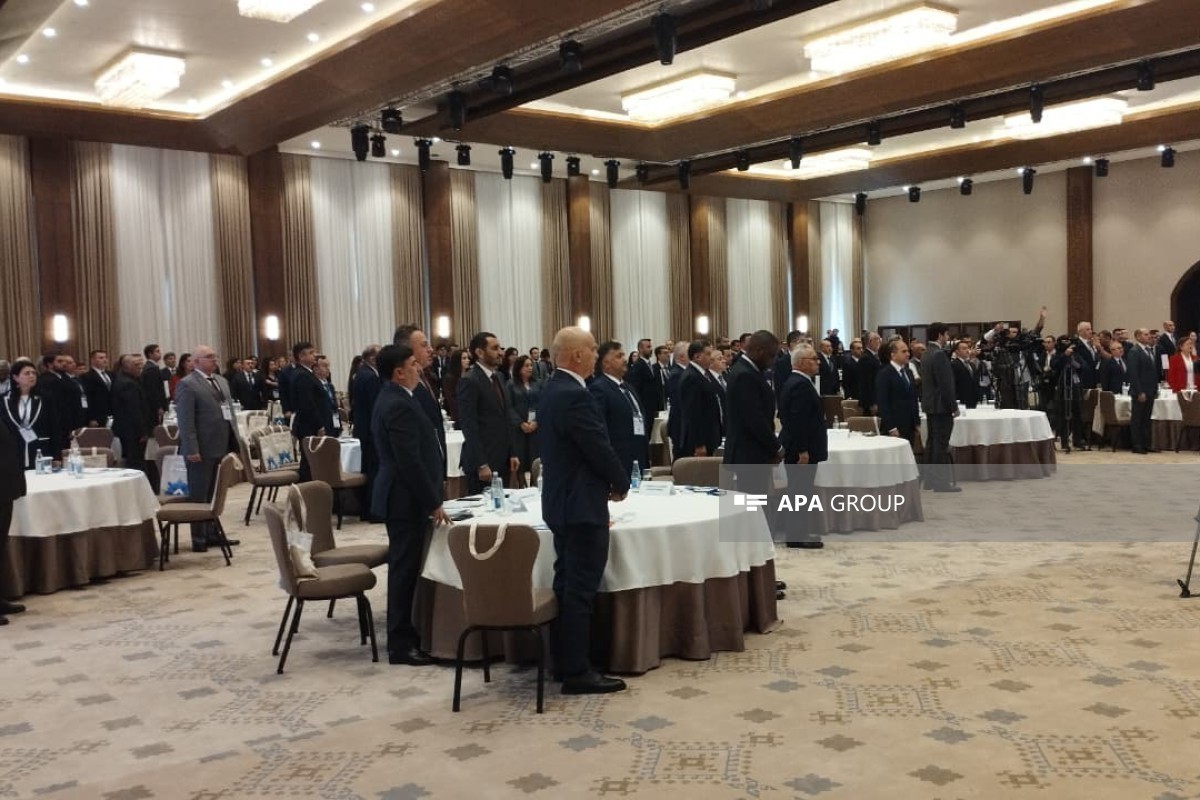
"At the 9th Congress of Azerbaijani Journalists held on October 16 this year, amendments to the 'Code of Ethical Conduct for Azerbaijani Journalists' were adopted. The amendments, arising from the demands of our time, focus on two main factors: artificial intelligence and the protection of personal rights," APA reports.
This was stated in a commentary by the Press Council regarding the decision of the 9th Congress of Journalists.
It was noted that the amendments aim to align both factors with media activities and increase the effectiveness of these activities in relation to them:
"At the 9th Congress, a sixth principle entitled 'Ethical Use of Artificial Intelligence,' consisting of four clauses, was added to the Code of Ethical Conduct for Azerbaijani Journalists. The first clause of this principle, 6.1, can be regarded as a call to action. In other words, media organizations are encouraged to adopt internal documents establishing rules for the use of artificial intelligence systems. These documents should clearly specify the purposes and limits of AI use, verification procedures, and editorial responsibility. This clause also includes a recommendation for media organizations to create appropriate conditions for improving their employees' skills in using artificial intelligence.
Clause 6.2 of the sixth principle added to the Code of Ethical Conduct for Azerbaijani Journalists is more focused on preventing the unquestioning acceptance of information generated by artificial intelligence and emphasizing the need to critically assess such information. Thus, while the newly added clause 6.1 promotes the use of artificial intelligence, clause 6.2 is based on a cautious approach to its use. The first sentence of the clause also supports this interpretation: 'The use of artificial intelligence systems must not replace a journalist's professional judgment, editorial independence, or human oversight."
According to the statement, clause 6.3 stipulates that before materials prepared with the help of artificial intelligence are published, their content, factual accuracy, and sources must be verified. This is because the responsible party is the journalist or the media organization for which they work: "We are talking about both ethical and legal responsibility. It should be taken into account that artificial intelligence tools sometimes make serious mistakes when responding to queries addressed to them, and sometimes raise issues unrelated to the topic. As is known, various types of content are currently being created with the help of artificial intelligence tools, and existing content is also being modified. Of course, it cannot be said that this is a negative phenomenon, provided that the intention and purpose are progressive and aimed at protecting public interests and benefits. However, even in such cases, readers must be informed about AI-generated content to ensure transparency and prevent the content from making it difficult for the audience to correctly understand the subject matter. More broadly, this is necessary to avoid creating the impression that a manipulative approach is being prioritized in meeting society's information needs. It should also be taken into account that such an impression could damage the credibility of the media or the journalist. In other words, alongside sharing information, the media or journalist must also consider protecting their reputation. Another requirement contained in clause 6.3 of the sixth principle added to the Code of Ethical Conduct for Azerbaijani Journalists stems precisely from these considerations."
It was noted that the fourth clause of the sixth principle added to the Code of Ethical Conduct for Azerbaijani Journalists (CECAJ) also stems from extremely important practical considerations of our time: "First of all, there is a need to focus on copyright. The fourth clause states that copyright must be respected when using artificial intelligence systems. In other words, a journalist or media organization must under no circumstances appropriate AI-generated content. As for the importance of protecting the confidentiality of personal data and sources, respecting human dignity, and adhering to the principle of non-discrimination, as stipulated in the same clause, we believe that there is also a direct call for responsibility here. Disregarding such responsibility is not only unacceptable from an ethical point of view but may also lead to the application of legal penalties. At the 9th Congress of Azerbaijani Journalists, further amendments to the CECAJ were made to the third principle, entitled 'Protection of Honor and Dignity, Inviolability of Private Life.' More precisely, five additional clauses were added to the principle, which previously consisted of 12 clauses. For reference, in December 2025, the Supreme Court of the Republic of Azerbaijan announced a new Plenum decision 'On the Protection of Personality Rights.' This decision, which is quite comprehensive in scope, also contains provisions concerning media activities, or more precisely, requiring the media and journalists to exercise sensitivity. The Supreme Court specifically drew attention to these provisions and provided detailed explanations in a statement issued in February this year. The amendments to the CECAJ are based on the institution's explanations. Thus, clause 3.13, added to the third principle of the CECAJ , entitled 'Protection of Honor and Dignity, Inviolability of Private Life,' focuses on the possibility of violations of personality rights through the use of information technologies that have become widespread in recent years. It should be noted that such trends are increasing and causing serious public dissatisfaction. It should also be taken into account that journalists actively use information technologies, including artificial intelligence systems, and the existing trend places them, as organized disseminators of information, in a position where they must adopt a more sensitive approach to personality rights. Therefore, clause 3.13 added to the CECAJ states that, except in cases established by law, journalists must not use information technologies to disclose information concerning the private lives of third parties, including information about their beliefs, religious and ethnic affiliation, and must be guided by the fact that the scope of personal data and the conditions for its processing, collection, transmission, use, and protection are determined by law."
It was stated that the provisions contained in another new clause of the CECAJ, clause 3.14, are also almost identical to the Supreme Court's explanation, and there is a need to elaborate on the issue: "While previously some people shared true information they knew about certain individuals, following the Supreme Court's new Plenum decision 'On the Protection of Personality Rights,' the unauthorized publication or sharing of any true information, more precisely, true information about any person, is no longer permissible. For this reason, the new clause 3.14 of the CECAJ states: 'Journalists must take into account that the truthfulness of a fact about a person whose life and activities are not of public significance does not allow that fact to be turned into news or immediately disseminated. If a person belonging to this category has not given consent, the collection, storage, and dissemination of their private information and details concerning their family life are unacceptable.' As is known, the Supreme Court's new Plenum decision 'On the Protection of Personality Rights' recognizes, so to speak, a degree of legitimate freedom for third parties to use information or photographs shared by individuals on their own social media accounts. In other words, everyone should be aware that by sharing certain photographs and information about themselves, they also make their private lives, to a certain extent, vulnerable. It is also known that social networks currently serve as sources of information for the media and journalists in many cases. Of course, the media mostly attaches news value to social media posts by individuals who are well-known in society. Taking this trend into account, the new clause 3.15 of the CECAJ states that 'when a journalist turns information shared by an individual on social networks and publicly accessible to everyone into news, they must refrain from mockery and a derogatory tone.' It should be noted that this requirement is similar to the provision contained in clause 5.7 of the fifth principle of the Code, entitled 'Protection of the Reputation of the Journalist and the Media Organization for Which They Work,' which states that 'journalists must refrain from using vulgar expressions and jargon in their writings and, while contributing to the enrichment of the Azerbaijani language, must also strive to preserve its purity.' We also note that, in general, the CECAJ focuses on three aspects in terms of the public interest criterion of materials disseminated by journalists. The first is the protection of health and safety, the second is the protection of the public from serious crimes and abuses of office, and the third is the elimination of the risk of the public being significantly misled."
It was noted that although the new clause 3.16 of the CECAJ, like the other newly added clauses, stems from the aforementioned Plenum decision of the Supreme Court, it also refers to the three aspects listed above: "Thus, this clause emphasizes that journalistic activity must primarily be guided by the public interest. Most importantly, it states: 'Every representative of a media organization or independent journalist must accurately determine whether the information or facts they disseminate about a particular person fall within the scope of public interest and must approach the matter with sensitivity.' Finally, we believe that the most important aspect of the amendments made to the CECAJ, more precisely, to the third principle of the Code entitled 'Protection of Honor and Dignity, Inviolability of Private Life,' based on the Supreme Court's new Plenum decision 'On the Protection of Personality Rights,' is reflected in clause 3.17. The first sentence of this clause states that the behavior, decisions, and activities of public figures have a direct or indirect impact on society, and this factor makes public scrutiny of their private lives a norm. However, 'even under such circumstances of openness, journalists must respect legitimate interests, must not go beyond the public interest, must focus on the specific areas of activity of public figures, and must not highlight unnecessary details unrelated to those activities.' In conclusion, it can be stated that the amendments made to the CECAJ at the 9th Congress of Azerbaijani Journalists, in addition to serving as a call for greater sensitivity among representatives of media organizations, journalists, and all those who consider themselves responsible for providing information to society, also expand the scope of their professional creativity in line with the demands of the new era. If the dissemination of information, news, or facts is based on the innovations reflected in the CECAJ, those engaged in this activity will be able to avoid potential problems and difficulties, and as a result, the media's function as the fourth estate will be performed more effectively. Of course, in general, maintaining responsible conduct arising from professional sensitivity is essential."


 Follow us on Telegram
 t.me/apanewsaz
 Follow us on Instagram
 Follow us on TikTok
 Follow us on Facebook
 Follow us on X

 UPDATED'>