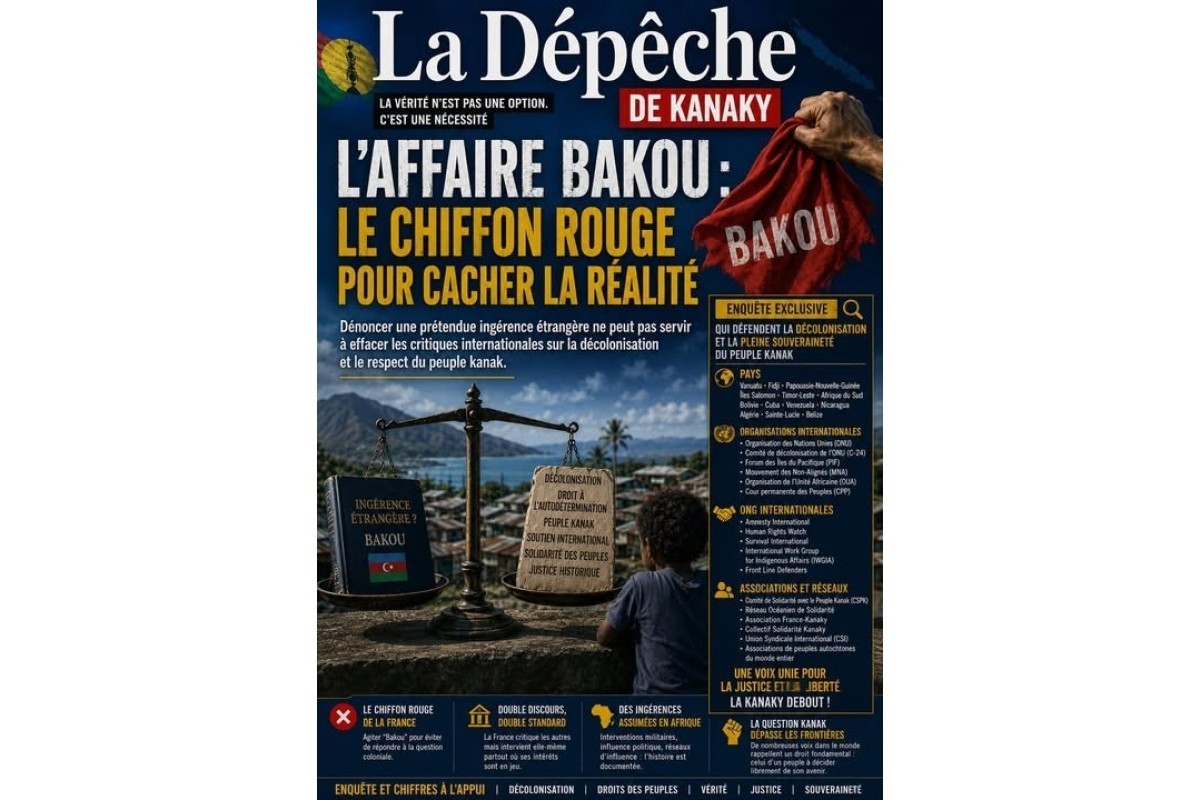


La Dépêche de Kanaky, a publication operating in Kanaky (New Caledonia), has published an extensive article titled "The Baku affair: A red herring to conceal the truth," APA reports.
The article criticizes the French authorities and loyalist circles for repeatedly placing Azerbaijan at the center of discussions on the Kanak issue.
Responding to accusations made by French lawmakers against Azerbaijan, supporters of New Caledonia's independence stated that turning official Baku into a target cannot remove the Kanak people's right to self-determination from the agenda.
The attempt by French political circles to make Azerbaijan the main target in the New Caledonia issue has drawn a strong reaction from Kanak independence supporters.
In a letter addressed to French Foreign Minister Jean-Noël Barrot, members of the French National Assembly Nicolas Metzdorf, Moerani Frébault, and Nicole Sanquer described Azerbaijani President Ilham Aliyev's position on France's Overseas Territories as "interference" and called on Paris to adopt tougher measures against Baku.
The same narrative has also been promoted in parts of the French media, where Azerbaijan is accused of undermining France's territorial integrity, building influence networks, and supporting independence movements in the Overseas Territories. Some reports have even called for sanctions and increased diplomatic pressure against Baku.
However, the response published by supporters of New Caledonia's independence in La Dépêche de Kanaky dismantles the political narrative promoted by Paris. Its central message is clear: Baku is not the cause of the debate but one of the actors highlighting a historical reality that France prefers not to confront.
According to Kanak activists, portraying Azerbaijan as a source of "foreign interference" serves to distract attention from the real issue. That issue is France's continued rule over New Caledonia, the obstacles facing the Kanak people's right to determine their political future, and the fact that the decolonization process remains unfinished.
Paris says "interference," the UN calls it decolonization
The most significant contradiction in the French lawmakers' letter is that the issue of New Caledonia is not merely France's "internal affair." New Caledonia remains on the UN list of Non-Self-Governing Territories to be decolonized, meaning that Paris' attempt to portray every country or organization addressing the issue as engaging in "interference" is inconsistent with its international obligations. The matter has long ceased to be an internal administrative issue for the French Parliament or government alone. It is a decolonization issue on the United Nations' agenda.
Official Baku's position: Human rights cannot be considered an internal matter
This was also the central message of President Ilham Aliyev's speech at the 4th Shusha Global Media Forum. The head of state presented Azerbaijan's position not as a bilateral confrontation with France, but within the framework of human rights and international obligations.
As the President stated, "Issues related to human rights are universal issues." From this perspective, France's response is an attempt to target the messenger rather than address the substance of the message. The Kanak people's demands were not created by Baku. Their struggle predates Azerbaijan's efforts to bring the issue to international platforms by many years. Azerbaijan has simply succeeded in bringing the long-overlooked issue of colonialism back onto the international agenda.
The Kanak response dismantles Paris' argument
The fact that the strongest response to the French lawmakers' letter targeting Azerbaijan came directly from New Caledonia is particularly significant.
Kanak independence supporters argue that repeatedly bringing up Baku's name does not conceal France's colonial past or its ongoing political responsibility. On the contrary, they say Paris' tendency to label every criticism as "foreign interference" demonstrates its unwillingness to listen to the voice of the Kanak people.
According to them, the question France should be answering is not, "Why is Azerbaijan speaking about this issue?"
The real questions are: Why does New Caledonia remain on the UN list of Non-Self-Governing Territories after 40 years? Why has the Kanak people's right to self-determination still not been resolved? Why does Paris attack international voices supporting the local population instead of listening to the political will of the Kanak people?
Although the French lawmakers' letter was intended to isolate Baku, it has had the opposite effect. The response from New Caledonia demonstrates that Azerbaijan is not speaking on behalf of others. Rather, it is providing a platform for peoples whose voices have long been marginalized in the international information space.
The French lawmakers' biased accusations against Azerbaijan do not diminish the Kanak people's demand for freedom, the UN's decolonization agenda, or the historical questions France must answer. The fundamental question remains: Why does colonialism still persist in the 21st century?


 Follow us on Telegram
 t.me/apanewsaz
 Follow us on Instagram
 Follow us on TikTok
 Follow us on Facebook
 Follow us on X