

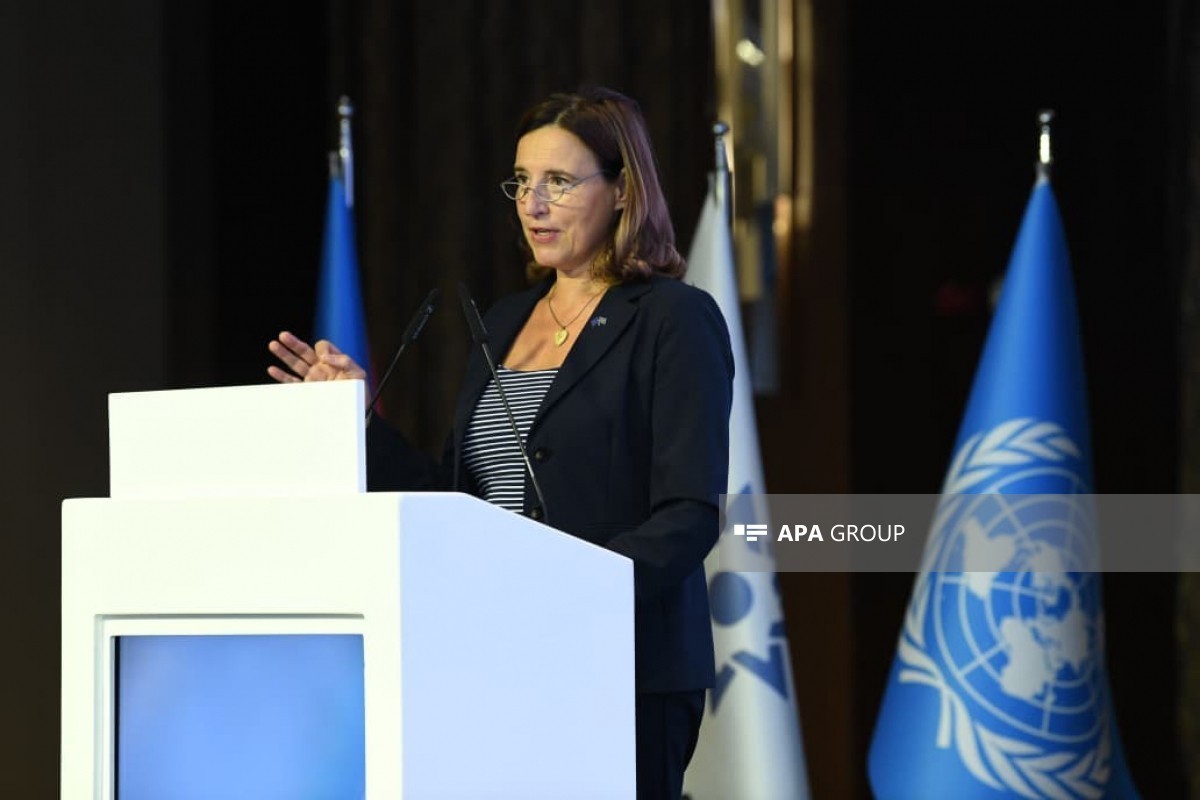


The European Union will continue its cooperation with Azerbaijan in addressing the threat posed by landmines, EU Ambassador to Azerbaijan Mariana Kujundžić said, APA reports.
She made the remarks while addressing the 4th International Conference on Mine Action, titled “Humanitarian Demining for Urban Recovery: Setting Excellence Standards for Safe Human Settlements,” in Baku.
Kujundžić praised Azerbaijan’s efforts to tackle the mine threat, stressing that humanitarian demining goes far beyond security.
“Humanitarian demining is also a prerequisite for recovery, reconstruction, human dignity and a return to normal life,” she said.
Referring to Croatia’s experience in mine action, the ambassador noted that addressing mine contamination is not limited to clearing affected territories. According to her, it also means creating conditions for people to return, rebuilding homes and public infrastructure, and helping communities restore stability and confidence in the future.
She emphasized that mine action and reconstruction should proceed in parallel, adding that recovery is more effective when it is based on long-term planning, strong institutions and the needs of affected communities.
Kujundžić also commended the work carried out by Azerbaijan, particularly by the Azerbaijan National Agency for Mine Action (ANAMA) and other operational actors in surveying and clearing contaminated areas, raising mine-risk awareness and assisting affected communities.
“We highly appreciate the significant efforts undertaken by Azerbaijan, particularly the work of ANAMA and other operational actors in surveying, clearance, awareness-raising and assistance to affected communities. We are proud to stand alongside Azerbaijan in these efforts,” she said.
The EU representative stressed that creating safe settlements should not be limited to removing explosive hazards. She said a settlement can be considered safe when families are able to return without fear, children can travel safely to school, public services can resume, reconstruction is carried out according to clear standards, and communities can rebuild their lives with confidence in the future.
According to Kujundžić, humanitarian demining should be viewed as part of a broader process aimed at creating safe, sustainable and inclusive settlements. She said Azerbaijan’s experience offers important lessons in this regard, not only because of the scale of contamination but also because of the complex task of linking mine clearance operations with reconstruction, the return of people and the region’s long-term development.
“This is a complex process, and sustained international cooperation remains of great importance,” she added.
Kujundžić reaffirmed the EU’s commitment to continuing cooperation with Azerbaijan in mine action.
“The European Union strongly supports this approach. Together with its member states, through the Team Europe initiative, the EU remains committed to contributing to the creation of a mine-free environment for communities and supporting sustainable development in the region. Today, our collective financial support directed to Azerbaijan under this commitment has reached 22 million euros,” she said.
The ambassador stressed that the ultimate objective is not simply to clear contaminated land, but to restore safety, enable people to return and rebuild communities.
“The European Union remains a reliable and long-term partner for Azerbaijan in mine action. We remain committed to supporting efforts that place humanitarian demining at the heart of safe settlements and the recovery process,” Kujundžić said.


 Follow us on Telegram
 t.me/apanewsaz
 Follow us on Instagram
 Follow us on TikTok
 Follow us on Facebook
 Follow us on X