

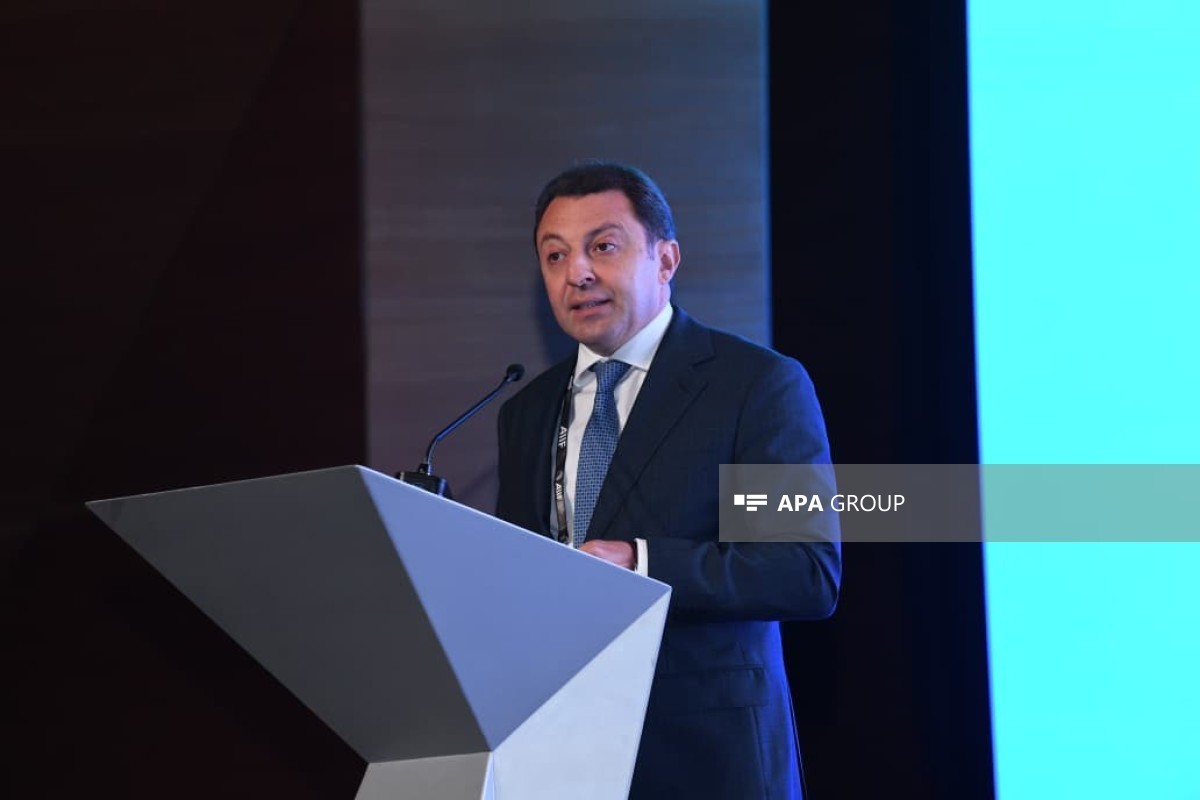


Azerbaijan has unilaterally lifted all transit restrictions related to Armenia, Deputy Foreign Minister Elnur Mammadov said during the panel session titled “Middle Corridor: Unlocking Trade, Industry and Connectivity Potential” held as part of the Second Azerbaijan International Investment Forum, APA reports.
“The leaders of Azerbaijan and Armenia signed a joint declaration with the participation and in the presence of US President Donald Trump, while the foreign ministers of the two countries signed the initialed text of the peace agreement. This laid the foundation for a path steering the South Caucasus region toward a prosperous future. Following this, Azerbaijan unilaterally lifted all transit restrictions related to Armenia. Over the course of one year, more than 60,000 tonnes of cargo have been transported from Azerbaijan to Armenia. Azerbaijan has also supplied more than 20,000 tonnes of petroleum products to Armenia. The two countries are currently continuing their efforts toward bilateral peace. The telecommunications operators of the two countries have also recently signed an agreement on internet connectivity, which will help increase reliability and support infrastructure development,” he said.
According to him, significant progress has been made in the development of the Zangezur Corridor.
Elnur Mammadov noted that 95% of the highway and 75% of the railway have already been constructed: “The remaining work is expected to be completed in the third quarter of next year. The TRIPP Development Company is currently being established. Engineering work has already begun in Armenia. Construction of the approximately 42-kilometer section of the route passing through Armenian territory is planned to begin early next year. This project has the potential to become a strategic connectivity and regional economic platform. It will connect the main part of Azerbaijan with Nakhchivan through Armenia and also link them more closely to the broader Trans-Caspian network. As you can see from the map, this route could play an important role in reducing cargo transportation time from the current three weeks to 12–15 days. It will become an additional component of the broader energy system, increase the diversification of energy sources, strengthen resilience and create new opportunities for economic cooperation in the South Caucasus."


 Follow us on Telegram
 t.me/apanewsaz
 Follow us on Instagram
 Follow us on TikTok
 Follow us on Facebook
 Follow us on X