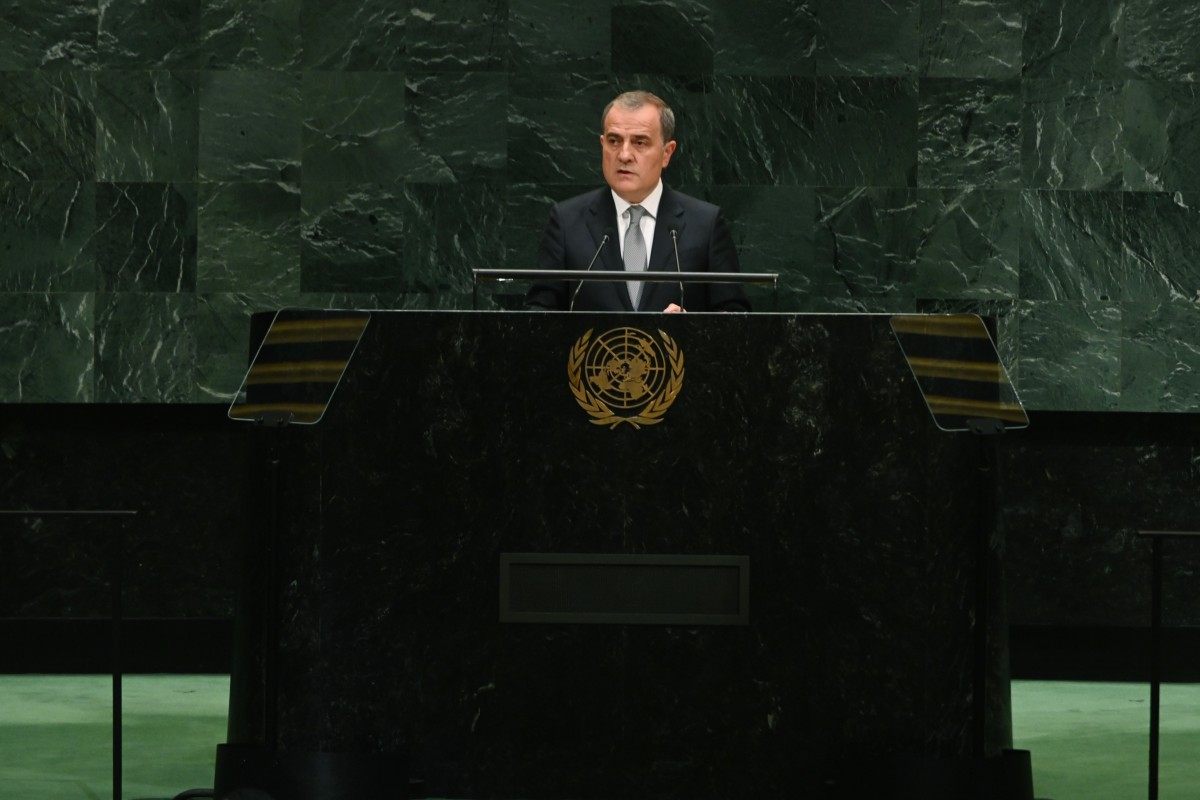


Azerbaijani Foreign Minister Jeyhun Bayramov addressed the 81st session of the UN General Assembly in New York, APA reports, citing the Ministry of Foreign Affairs of Azerbaijan.
Jeyhun Bayramov emphasized the importance of a reinvigorated and reformed multilateral system based on strict adherence to international law, the sovereign equality of states and the principle of non-interference in internal affairs. The minister stressed the urgent need to reform the UN Security Council to ensure fair representation of developing countries.
The Foreign Minister noted that de facto peace has been achieved between Azerbaijan and Armenia following the Washington Peace Summit. According to him, the peace agenda is already producing tangible economic results, including the unilateral lifting of transit restrictions and the establishment of bilateral trade in certain areas. The minister also drew attention to the importance of removing the remaining obstacles to the signing of the Peace Agreement.
Bayramov said that as a result of post-conflict rehabilitation and reconstruction efforts, more than 90,000 Azerbaijani citizens have returned to the liberated territories.
The minister stressed that the threat posed by landmines persists, noting that more than 400 people have become victims of landmines since 2020, while the total number of mine victims over the past 30 years has exceeded 3,500. He said humanitarian demining has been formally declared Azerbaijan’s 18th National Sustainable Development Goal.
Jeyhun Bayramov called for international support in determining the fate of nearly 4,000 people who went missing as a result of the conflict in order to advance post-conflict reconciliation and accountability.
The Foreign Minister also spoke about Azerbaijan’s role in developing regional connectivity. He said cargo volumes along the Middle Corridor have increased by almost 90%, with the Baku International Sea Trade Port and the Baku-Tbilisi-Kars railway contributing to the development of more resilient and diversified supply chains between Asia and Europe.
The minister emphasized the importance of developing the “Trump Route for International Peace and Prosperity” (TRIPP) to establish unimpeded multimodal connectivity between the main part of Azerbaijan and the Nakhchivan Autonomous Republic. He also highlighted efforts to expand regional digital connectivity through the Digital Silk Way fiber-optic network across the Caspian Sea.
Touching upon Azerbaijan’s economic indicators, Bayramov said the country’s GDP has increased threefold, while the poverty rate has declined from 49% to around 5%.
The minister said Azerbaijan is a reliable natural gas supplier to 16 countries while also accelerating its transition to clean energy. According to him, agreements envisage around 6 GW of additional solar and wind capacity by 2030, with renewables expected to generate almost 40% of Azerbaijan’s electricity by that year.
The speech also highlighted Azerbaijan’s role during COP29 in tripling the global climate finance goal, operationalizing carbon-market mechanisms under Article 6 of the Paris Agreement, advancing arrangements supporting the Loss and Damage Fund, and subsequently hosting the UNFCCC Climate Week. Azerbaijan’s contribution to the global urban agenda through hosting WUF13 was also noted.
Jeyhun Bayramov described the declining level of the Caspian Sea as an urgent environmental challenge and called on the Caspian littoral states for a coordinated, collective and sustained response.
The minister said Azerbaijan’s ASAN and DOST models have gained international recognition. He noted that Azerbaijan’s experience in transparent, accountable and efficient public service delivery was reflected in a UN Human Rights Council resolution co-sponsored by more than 100 member states.
He also noted that since 2020, Azerbaijan has provided humanitarian, economic and technical assistance worth approximately $400 million to more than 140 countries, with particular attention to Small Island Developing States and African countries.


 Follow us on Telegram
 t.me/apanewsaz
 Follow us on Instagram
 Follow us on TikTok
 Follow us on Facebook
 Follow us on X