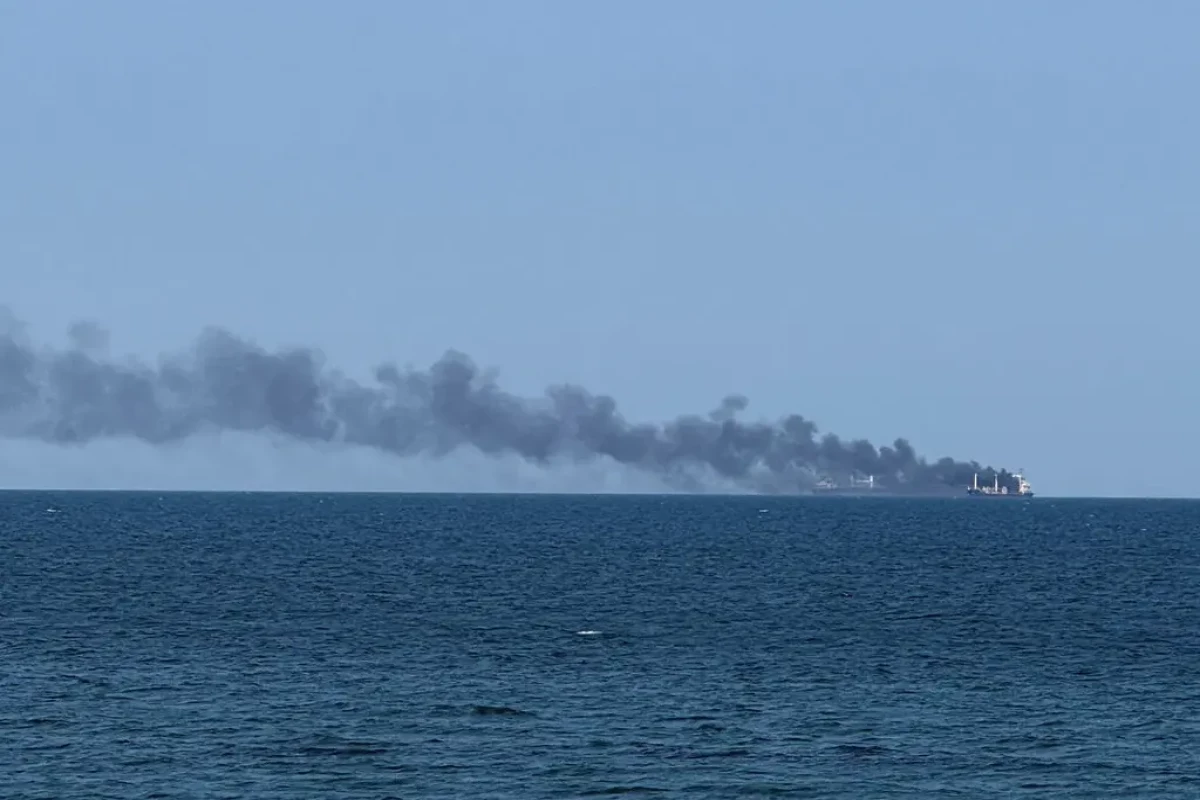


As families strolled along a promenade in the Ukrainian port city of Odesa recently, a lone cargo ship sailed in the distance, NYC reports.
Suddenly, a drone dropped out of the clear blue sky and slammed into the vessel, sending smoke billowing across the horizon.
The attack, which I witnessed in late July, was part of a Russian campaign targeting cargo vessels that has halted nearly all shipping in and out of Odesa, Ukraine’s most crucial link to the world economy.
Coming at the start of the harvest season, the Russian campaign in Ukraine, which is a major producer of grains like wheat, corn and barley, could throw global food supply chains into turmoil. In 2022, during the first months of the full-scale war, Russia established a blockade of Ukrainian ports, causing a spike in global food prices and placing an estimated 70 million people at increased risk of acute food insecurity.
“Russia is hunting these vessels,” Dmytro Barinov, president of the Ukrainian Ports Association, said in an interview. “It’s a professional hunting for civilian vessels.”
The Russian strikes are the latest chapter in a long-running battle over the Black Sea and the adjacent Sea of Azov. New weapons that allow for precision targeting at great distances have made slow-moving cargo vessels easy targets. In June and July, Russian forces attacked at least 50 cargo ships, according to Ukrainian officials, killing more than 30 civilians.
Ukraine has also systematically targeted Russian-linked tankers and cargo vessels. Moscow’s maritime campaign appears to be a response to Ukraine’s decimation of the Russian fleet of river-sea oil tankers in the Sea of Azov and to Kyiv’s continued targeting of ships transporting Russian goods, which has left occupied Crimea isolated and starved for fuel.
Ukraine’s latest major assault took place before dawn on Wednesday, when the country’s forces attacked the Russian port of Novorossiysk, on the Black Sea, with jet-powered drones, missiles and unmanned naval systems, President Volodymyr Zelensky said. Air defense positions, piers and seaport infrastructure were struck, he said.
Three people died, including an 8-year-old child, and about 60 residential buildings were damaged, Veniamin Kondratyev, the governor of the Krasnodar region, which includes Novorossiysk, said on social media. Andrei Kravchenko, the mayor of the city, which is a critical hub for grain exports, declared a state of emergency. He said the city’s water supply had been suspended after two mains were damaged.
The escalating battle between Russia and Ukraine is a flashpoint in a larger global phenomenon that threatens one of the foundational tenets of the international order: freedom of navigation.
That maritime system, which underpins modern global commerce, is under strain as state and nonstate actors increasingly use drones, anti-ship missiles and mines to disrupt routes, particularly in places like the Red Sea and the Strait of Hormuz. The strait, a key conduit for oil and gas, has effectively been closed since the United States and Israel attacked Iran in February.
At the port in Odesa and two others nearby, the Russian blockade could trap millions of tons of grain. The three ports account for about 60 percent of Ukraine’s total monthly export revenue of $3.5 billion. The Ukrainian Agri Council, a trade group, has warned of a potential wave of bankruptcies and has pleaded for emergency loans and state guarantees.
The situation has echoes of the 2022 Russian blockade on Ukrainian ports. In July that year, the United Nations and Turkey brokered the Black Sea Grain Initiative, which allowed shipping to resume. The deal fell apart a year later. But by that point, Ukraine had driven Russian warships out of the northwestern part of the Black Sea and was largely able to continue shipping.


 Follow us on Telegram
 t.me/apanewsaz
 Follow us on Instagram
 Follow us on TikTok
 Follow us on Facebook
 Follow us on X