

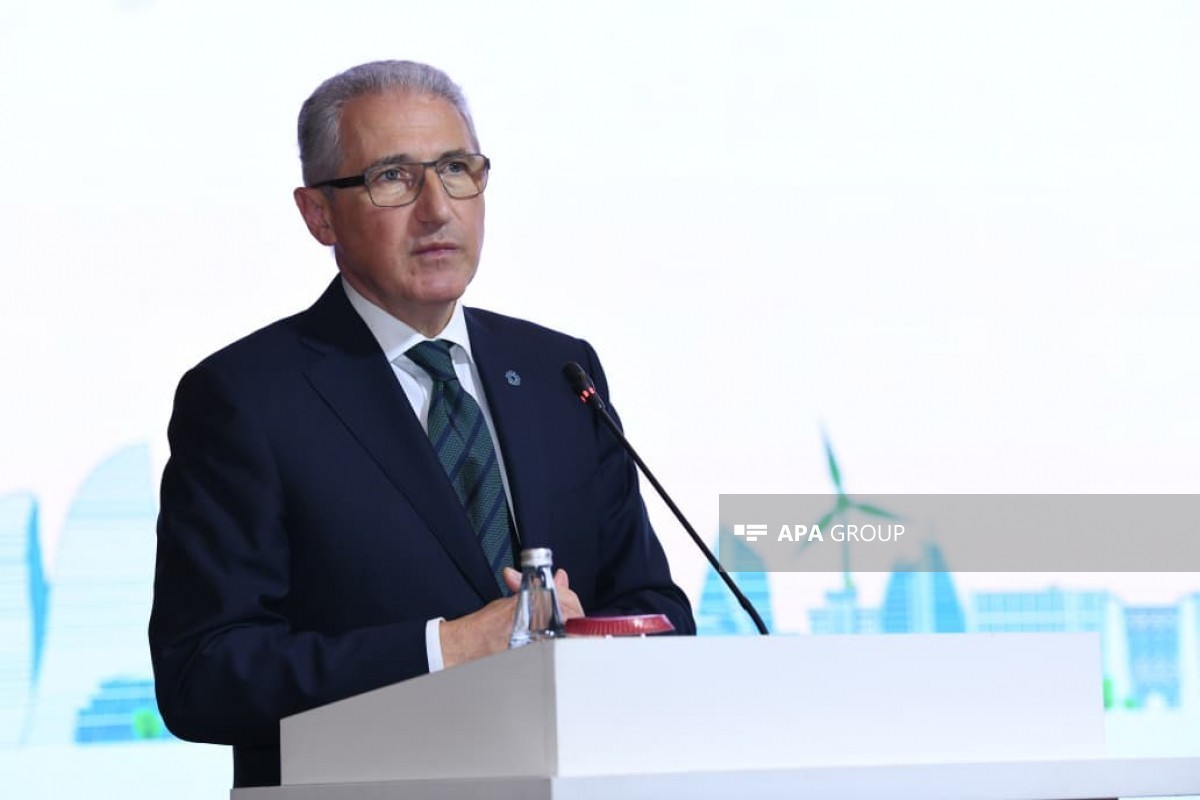


Climate change is already changing investment models, business competitiveness, and the structure of economies, Representative of the President of Azerbaijan on Climate Issues Mukhtar Babayev said at a roundtable held in Baku as part of the Fourth Climate Week of the UN Framework Convention on Climate Change (UNFCCC), hosted by the Republic of Azerbaijan and organized by the Ministry of Foreign Affairs, APA reports.
He said that climate targets are implemented through decisions made in the real economy: “According to the World Bank, in developing economies, the private sector accounts for 90% of jobs, 75% of investment, and more than 70% of economic output.
For this reason, the role of the private sector is of fundamental importance. Many renewable energy and electrification technologies are already commercially viable and competitive. However, in the cement, steel, chemical, aviation, and shipping sectors, many solutions are still too expensive, require major infrastructure, or are not yet commercially mature enough and are not being deployed at scale. We must implement solutions that already work, while accelerating innovation and technology transfer in areas where solutions are still at the development stage.”
The President’s representative noted that financing demonstrates the scale of the challenge ahead: “Simply calling for more private finance will not change the situation. Private capital acts by taking risk and return factors into account. To facilitate the financing of projects, we need guarantees, blended finance, and risk sharing.
Banks must also make climate finance part of their core activities. Climate factors should be part of everyday banking and investment decisions. Climate policy is also increasingly being linked to trade and industrial policy. Different countries have different levels of access to finance, technology, and infrastructure.
High standards should support transformation while also expanding opportunities for developing economies. Technology must be affordable, accessible, and ready for deployment at scale. Climate action must support development. The transition requires large-scale technology, affordable finance, and predictable policies. This is how climate action can ensure competitiveness and sustainable growth. As we move toward COP31, this is precisely the contribution we need from business.”


 Follow us on Telegram
 t.me/apanewsaz
 Follow us on Instagram
 Follow us on TikTok
 Follow us on Facebook
 Follow us on X